
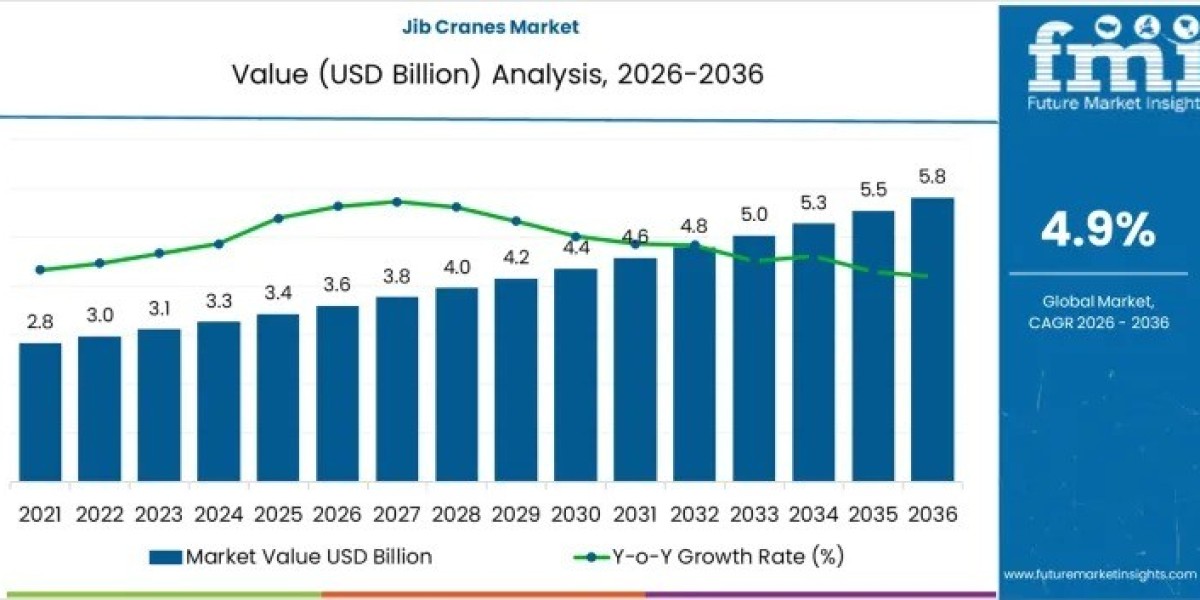
The global Jib Cranes Market is projected to grow from USD 3.6 billion in 2026 to USD 5.8 billion by 2036, registering a CAGR of 4.9%. Growth is not driven by large infrastructure megaprojects, but by continuous, incremental investments at the factory and workshop level. Jib cranes are purchased to solve specific lifting and positioning challenges at individual workstations, maintenance bays, and assembly cells.
Cost structures play a decisive role in profitability. Differences in steel fabrication, bearing assemblies, and installation labor influence margins more than shipment volumes. Manufacturers with vertically integrated fabrication and standardized designs maintain stronger pricing control, while assemblers dependent on outsourced structures face narrower margins. Value capture concentrates among suppliers that manage engineering approvals, compliance documentation, and site acceptance testing, as these elements are embedded into contract pricing.
Margin Performance Depends on Contract Structure and Service Bundling
Across the forecast period, margin outcomes depend more on contract structure than headline project counts. Turnkey suppliers that bundle foundations, erection, inspection, and certification services consistently preserve higher contribution margins.
Key profitability drivers include:
- Control over engineering approvals and installation certification
- Bundled service offerings rather than component-only sales
- Proprietary mounting systems and accessories that influence specifications
While public and industrial tenders apply downward pressure on unit pricing, service, inspection, and modification work provides a stable earnings layer that is less exposed to price competition. As a result, economic returns remain concentrated among a limited group of manufacturers with fabrication scale and certification reach.
Subscribe for Year-Round Insights → Stay ahead with quarterly and annual data updates:
https://www.futuremarketinsights.com/reports/sample/rep-gb-30998
Growth Through 2031 Anchored in Factory Modernization
Between 2026 and 2031, the jib cranes market expands in line with a 4.9% CAGR, reflecting steady investment in factory modernization rather than greenfield construction. Jib cranes are typically installed to improve ergonomics, reduce manual handling risk, and enhance productivity at specific workstations.
Demand is supported by:
- Metalworking and general manufacturing
- Automotive component production
- Maintenance and repair operations
Purchasing decisions emphasize robustness, ease of installation, and compatibility with existing floor layouts rather than automation sophistication. This keeps the market focused on practical, application-specific solutions.
From 2031 to 2036, Density and Safety Drive Incremental Demand
By 2036, the market reaches USD 5.8 billion as production environments become denser and safety expectations increase. As factories adopt compact layouts and higher product mix, point-of-use lifting solutions become more valuable than centralized overhead systems.
Key demand drivers in this phase include:
- Increased number of workstations per facility
- Replacement of older cranes to meet updated safety standards
- Greater emphasis on ergonomic lifting and injury reduction
Competitive positioning remains tied to reliability, installation support, and coverage of load ranges and mounting configurations rather than technological differentiation.
Freestanding Jib Cranes Lead by Mounting Configuration
Freestanding jib cranes account for approximately 42% of global demand in 2026. Their dominance reflects structural independence and wide service coverage.
Reasons for leadership include:
- 360-degree rotation enabling flexible work zones
- No reliance on building walls or columns
- Easier relocation when production layouts change
Wall-mounted, folding, and articulating jib cranes serve more constrained layouts. While effective for specific access challenges, their dependence on building structures, limited rotation, or higher maintenance costs keeps their adoption more selective.
Manufacturing Remains the Largest End-Use Segment
Manufacturing represents about 45% of jib crane demand in 2026. Factories involve frequent, repetitive handling of parts and tools at fixed locations, making jib cranes ideal for machine tending, assembly, and maintenance operations.
Manufacturing demand is sustained by:
- High density of lifting points across shop floors
- Flexibility to add or reposition cranes as processes evolve
- Reduced dependence on forklifts and overhead cranes
Automotive, construction, and warehousing show lower relative demand due to greater reliance on integrated handling systems, mobile equipment, or palletized workflows.
Regional Growth Reflects Industrial Expansion Patterns
Growth varies by region based on industrial density and modernization activity:
- India (5.6% CAGR): Driven by SME manufacturing growth and mechanization
- China (5.3% CAGR): Supported by dense manufacturing clusters
- Brazil (4.9% CAGR): Linked to industrial modernization and logistics investment
- USA (4.5% CAGR): Replacement demand and compliance upgrades
- UK (4.2% CAGR): Industrial upgrades and safety-driven adoption
Across regions, investment decisions prioritize structural reliability, load capacity, and regulatory compliance.
Competitive Landscape Defined by Reliability and Service Reach
Leading suppliers including Konecranes, Mitsubishi Logisnext, Demag Cranes & Components, Columbus McKinnon, ABUS Kransysteme, Terex, and Yale compete on durability, modularity, and service coverage. Differentiation is shaped by:
- Load range and mounting flexibility
- Ease of installation and maintenance
- Compliance with regional safety standards
Suppliers with strong field service networks and customization capabilities maintain long-term relevance across diverse industrial applications.
Long-Term Outlook: Practical Lifting Solutions Sustain the Market
The jib cranes market grows in step with how work is organized on factory floors, not with macro investment cycles. As manufacturers seek localized lifting, shorter changeovers, and improved safety, jib cranes remain essential point-of-use tools. While geometry, load limits, and capital discipline restrict broader deployment, these systems continue to deliver predictable, steady growth through 2036.