
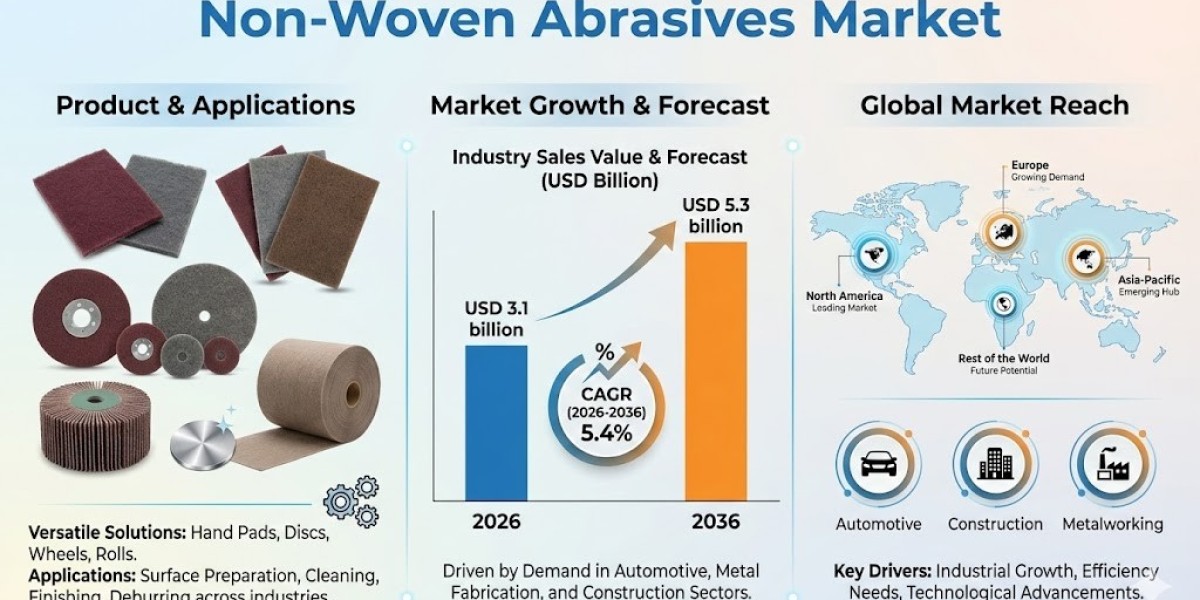
The Non-Woven Abrasives Market is demonstrating resilient, growth-oriented momentum as industries prioritize surface quality, operational efficiency, and precision manufacturing. According to recent market analysis, the industry is forecast to expand from USD 3.1 billion in 2026 to USD 5.3 billion by 2036, reflecting a CAGR of 5.4% over the ten-year period. This growth positions non-woven abrasives as a critical component within the broader abrasives and industrial finishing ecosystem.
Manufacturers across automotive, metal fabrication, aerospace, construction, and electronics are increasingly shifting toward non-woven solutions due to their ability to deliver uniform finishes, reduced heat generation, and longer consumable life compared to conventional bonded or coated abrasives.
Subscribe for Year-Round Insights → Stay ahead with quarterly and annual data updates
https://www.futuremarketinsights.com/reports/sample/rep-gb-31017
Market Expansion Supported by Absolute Revenue Growth
The compound absolute growth trajectory highlights steady and predictable market expansion. Between 2026 and 2030, revenues are expected to rise from USD 3.1 billion to approximately USD 3.8–4.0 billion, driven by rising adoption in surface conditioning, deburring, and pre-coating preparation. This phase reflects growing awareness among manufacturers of the productivity gains achievable through consistent surface finishing.
From 2030 to 2036, the market is projected to add over USD 1.3 billion in incremental value. This later-stage growth is expected to be fueled by increased use of non-woven abrasives in precision applications, including polishing and fine finishing of advanced materials such as aluminum alloys, composites, and high-strength steels.
Synthetic Fiber Non-Wovens Dominate Material Demand
By material type, synthetic fiber non-wovens account for nearly 52% of total market share, making them the leading segment. Their dominance is attributed to:
- Higher tensile strength and uniformity compared to natural fibers
- Superior durability in high-speed and automated applications
- Customizable structures that balance cut rate and surface integrity
These attributes make synthetic fiber non-wovens the preferred choice in automotive, aerospace, and heavy machinery manufacturing, where consistent results and process repeatability are essential.
Automotive & Transportation Remains the Largest End-User Segment
Automotive and transportation applications represent around 40% of total market demand, underscoring their role as the primary growth engine. Non-woven abrasives are widely used for:
- Paint preparation and surface blending
- Rust and coating removal
- Polishing of body panels, wheels, and engine components
The ongoing shift toward electric vehicles is further strengthening demand, as EV platforms rely heavily on aluminum structures and precision-finished components that require controlled surface conditioning.
Regional Insights Highlight Emerging and Mature Market Balance
Geographically, the market shows a balanced mix of mature and high-growth regions:
- India leads with a projected CAGR of 6.8%, supported by rapid industrialization, automotive expansion, and infrastructure development.
- China follows closely at 6.3%, driven by large-scale manufacturing and electronics production.
- USA maintains steady growth at 6%, backed by aerospace, automotive, and advanced manufacturing investments.
- Germany and Japan continue to grow at moderate rates, reflecting their focus on precision engineering and high-quality manufacturing standards.
This regional diversity reduces market volatility and supports long-term stability.
Key Market Drivers Strengthening Adoption
Several structural factors are accelerating adoption of non-woven abrasives:
- Rising demand for consistent surface finishes across industries
- Integration with automated and robotic finishing systems
- Increased use of lightweight and advanced materials
- Focus on sustainability through longer-lasting, waste-reducing consumables
These drivers collectively reinforce the market’s growth outlook through 2036.
Competitive Landscape Focused on Innovation and Performance
The non-woven abrasives market remains fragmented yet competitive, with key players including 3M Company, Norton Abrasives (Saint-Gobain), KLINGSPOR AG, Weiler Abrasives Group, Mirka Ltd., Dynabrade, SIA Abrasives, Festool, Walter Surface Technologies, and Rhodius Schleifmittel GmbH.
Leading companies are investing in:
- Product innovation to enhance durability and cut consistency
- Application-specific solutions for automated production lines
- Sustainability-focused designs to reduce environmental impact
Firms that combine strong customer relationships with efficient production capabilities are expected to capture greater market share over the forecast period.
Strategic Outlook Through 2036
Looking ahead, the non-woven abrasives market is well-positioned for sustained expansion as manufacturers seek reliable, high-performance surface finishing solutions. While challenges such as cost sensitivity and competition from alternative finishing technologies persist, ongoing innovation and automation integration are expected to offset these constraints.