
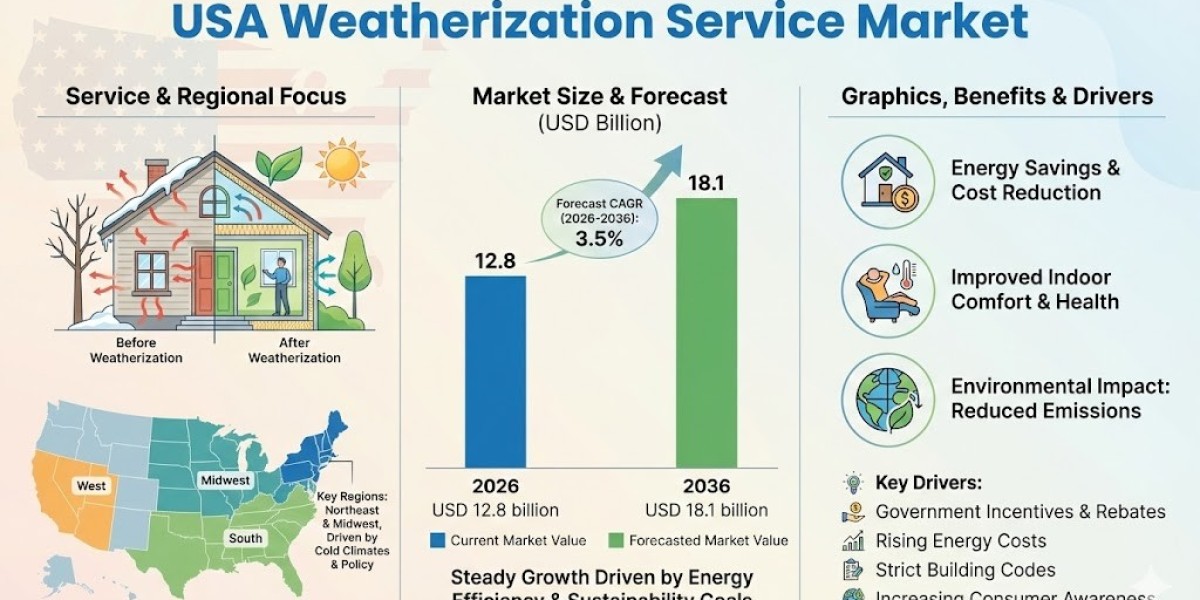
The Demand for Weatherization Service in USA is estimated at USD 12.8 billion in 2026 and is projected to reach USD 18.1 billion by 2036, reflecting a CAGR of 3.5%. Residential and commercial property owners are increasingly prioritizing energy efficiency to reduce utility costs, improve building thermal performance, and lower environmental impact. Federal and state programs supporting energy retrofits, combined with rising energy prices and aging buildings, continue to propel the adoption of weatherization services across multiple income segments.
Subscribe for Year-Round Insights → Stay ahead with quarterly and annual data updates: https://www.futuremarketinsights.com/reports/sample/rep-gb-29918
Service providers are focusing on insulation upgrades as the leading intervention, complemented by air sealing, duct optimization, and ventilation improvements to achieve measurable energy savings. High-performance insulation materials not only reduce air leakage and moisture intrusion but also enhance overall indoor comfort, making them a critical choice in weatherization projects.
Regional Market Dynamics
West USA: The West region exhibits the highest growth potential with a projected CAGR of 4.0%. High energy prices, climate variability, and robust policy support drive widespread adoption in single-family homes, multi-family buildings, and public housing. Utility-sponsored efficiency programs emphasize insulation, air sealing, window retrofits, and duct optimization. Retrofits are increasingly aligned with electrification goals, wildfire resilience, and indoor air quality improvements, while certified audits ensure data-driven and efficient project execution.
South USA: With a CAGR of 3.6%, the South’s weatherization demand is shaped by cooling-intensive climates, low-income housing initiatives, and public assistance programs. Contractors focus on attic insulation, duct sealing, reflective roofing, and moisture control to reduce air-conditioning loads and manage peak electricity demand. Scalable service models ensure that large volumes of residential buildings can be efficiently retrofitted while maintaining energy performance standards.
Northeast USA: The Northeast shows a CAGR of 3.2%, reflecting the region’s cold climate, older building stock, and strict energy efficiency regulations. Weatherization projects focus on wall insulation, air leakage reduction, window performance improvements, and heating system optimization. Compliance with state energy codes and carbon-reduction goals supports continued retrofit activity, while energy audits provide actionable insights to prioritize interventions for maximum efficiency.
Midwest USA: Demand in the Midwest is stable, with a CAGR of 2.8%, driven by seasonal heating requirements and publicly funded programs. Weatherization services focus on insulation, air sealing, and heating efficiency measures in single-family homes, rural housing, and community buildings. Cost-effective solutions are prioritized to maximize energy savings, particularly in regions with older housing or limited funding.
Service Type Insights
Insulation upgrades dominate the weatherization services market, accounting for the largest share due to their direct impact on energy efficiency. By enhancing walls, roofs, and floors, insulation significantly reduces heat transfer, leading to measurable energy savings and improved thermal comfort throughout the year.
- Air Sealing: Complementary air sealing services minimize uncontrolled airflow, ensuring insulation performs at its maximum potential.
- Energy Audits: Comprehensive audits guide property owners in prioritizing interventions that deliver the highest impact, optimizing both cost and energy savings.
- Additional Measures: Window and door weatherization and duct sealing further reinforce energy efficiency, reducing drafts, preventing heat loss, and improving HVAC system performance.
Together, these service types provide an integrated approach that enhances building envelope performance, lowers utility costs, and improves occupant comfort.
Material Preferences
Spray foam insulation leads the market with a 36% share, highly valued for its dual functionality of insulating and sealing air gaps in a single application. Its high thermal performance makes it ideal for both retrofit projects and new construction.
- Cellulose Insulation: Recognized for its cost-effectiveness and sustainability, cellulose offers an eco-friendly alternative that delivers consistent thermal improvement.
- Reflective Insulation: Designed for radiant heat control, reflective insulation is particularly effective in regions with high solar exposure or extreme temperatures.
- Bio-Based Materials: Materials derived from renewable sources are gaining traction in projects emphasizing environmental sustainability, appealing to both regulatory and consumer-driven demands.
The market demonstrates a clear preference for materials that combine high performance with adaptability across residential and light commercial structures, allowing contractors to select solutions tailored to specific building needs.
End-User Segmentation
Residential buildings represent the largest segment of the USA weatherization market, holding 41% of total demand. Growth in this segment is fueled by aging single-family and multi-family housing, alongside government and utility incentives for energy retrofits.
- Commercial Buildings: Businesses adopt weatherization services primarily to manage operating costs, maintain energy benchmarks, and improve employee comfort.
- Industrial Facilities: Weatherization is applied selectively in offices or controlled environments to optimize energy usage without disrupting production processes.
- Public and Government Buildings: Efficiency initiatives in these sectors are policy-driven, ensuring compliance with state and federal energy reduction targets.
This segmentation underscores the critical role of residential retrofits as the primary driver of market expansion, while commercial, industrial, and public sectors continue to provide steady, complementary demand for weatherization services.
Competitive Landscape
The USA weatherization service market is highly competitive, with leading players excelling in program management, large-scale retrofits, and data-driven solutions:
- Ameresco: Provides nationwide audits, energy efficiency services, and retrofit implementation for residential and community programs.
- ICF: Specializes in large-scale program administration, contractor management, and verification services to support weatherization initiatives.
- CLEAResult: Operates extensive utility programs offering weatherization measures, outreach, and quality assurance across multiple states.
- Franklin Energy: Offers field services, workforce training, and incentive program delivery for residential efficiency upgrades.
- AECOM: Provides engineering, program design, and implementation support for state and municipal projects.
These companies leverage regulatory compliance, workforce expertise, geographic coverage, and multi-stakeholder coordination to maintain leadership in the USA market.
Market Outlook
The demand for weatherization services in the USA is expected to grow steadily over the next decade, driven by federal and state efficiency programs, energy cost pressures, and aging housing stock. Insulation upgrades, complemented by air sealing and energy audits, remain the most impactful interventions. Adoption trends highlight the importance of audit-driven, data-backed retrofits delivered by certified contractors to achieve energy savings, reduce utility costs, and enhance indoor comfort.