
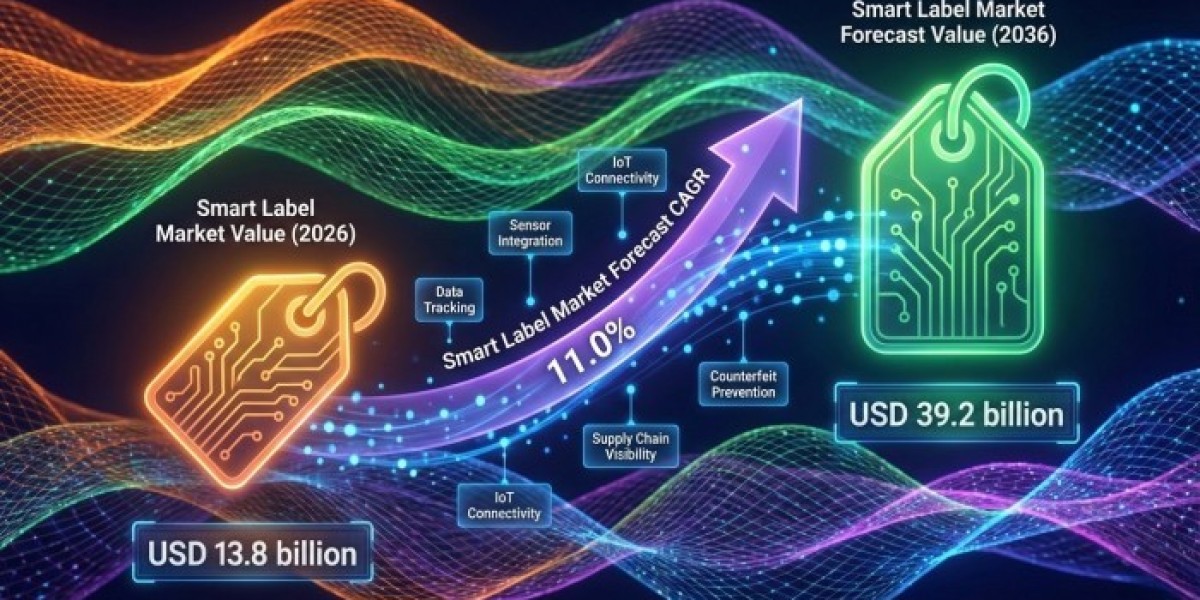
The global smart label market is entering a sustained expansion phase as industries accelerate the adoption of digitally enabled labeling systems for inventory visibility, authentication, and real-time supply chain monitoring. According to the latest market outlook, the smart label market is valued at USD 13.8 billion in 2026 and is projected to reach USD 39.2 billion by 2036, growing at a compound annual growth rate (CAGR) of 11.0% over the forecast period.
Smart labels—integrating technologies such as radio frequency identification (RFID), near-field communication (NFC), electronic shelf labels, and sensor-enabled formats—are increasingly embedded into packaging and logistics workflows to connect physical products with digital enterprise systems. Adoption is being driven by the need for accurate tracking, regulatory compliance, anti-counterfeiting, and automated inventory management across retail, logistics, healthcare, food, and industrial manufacturing sectors.
Discover Growth Opportunities in the Market – Get Your Sample Report Now
https://www.futuremarketinsights.com/reports/sample/rep-gb-2704
Market Snapshot: Smart Label Industry at a Glance
- Market value (2026): USD 13.8 billion
- Forecast value (2036): USD 39.2 billion
- Forecast CAGR (2026–2036): 11.0%
- Leading technology segment: RFID labels
- Largest end-use segment: Retail and e-commerce
- High-growth countries: China, India, South Korea
Why the Smart Label Market Is Expanding
The expansion of the smart label market reflects structural changes in how products are identified, monitored, and authenticated throughout their lifecycle. Manufacturers and retailers are deploying smart labels to improve traceability, reduce manual intervention, and enable real-time data capture across complex supply chains.
Key growth drivers include:
- Rising demand for automated inventory visibility in large-scale retail and logistics networks
- Increased focus on product authentication and anti-counterfeiting, particularly in pharmaceuticals and high-value consumer goods
- Regulatory pressure for traceability and compliance in food, beverage, and healthcare supply chains
- Growth of connected packaging and integration with enterprise resource planning (ERP) and warehouse management systems
Smart labels allow organizations to monitor product movement, origin, condition, and authenticity, supporting data-driven logistics and operational efficiency.
RFID Labels Lead by Technology Type
RFID labels represent the dominant technology in the smart label market, accounting for 52% of total market share in 2026. Their leadership is supported by wide deployment in inventory management, asset tracking, and supply chain operations.
RFID adoption is reinforced by:
- Compatibility with automated scanning and identification systems
- High read accuracy in high-volume environments
- Infrastructure standardization across retail, logistics, and industrial sectors
NFC labels and sensing labels are gaining momentum in consumer engagement and condition monitoring applications, while electronic shelf labels are increasingly used in organized retail for automated pricing and stock visibility.
Retail and E-commerce Remain the Largest End-Use Segment
Retail and e-commerce account for 38% of smart label demand in 2026, reflecting the sector’s reliance on accurate inventory management and omnichannel distribution.
Smart labels support retailers by enabling:
- Real-time inventory validation across physical and digital channels
- Reduced shrinkage and improved stock replenishment
- Product authentication and interactive consumer information
- Integration with automated checkout and restocking systems
Continued expansion of organized retail formats and online marketplaces is sustaining long-term demand.
Regional Growth Patterns Highlight Asia’s Momentum
The smart label market is expanding globally, with Asia demonstrating the strongest national growth rates:
- China: 13.2% CAGR
- India: 12.8% CAGR
- South Korea: 11.5% CAGR
- United States: 10.5% CAGR
- Germany: 9.8% CAGR
- Japan: 9.5% CAGR
- United Kingdom: 9.1% CAGR
China and India are benefiting from high-volume manufacturing, export-driven logistics, and accelerating digitization of retail and pharmaceutical supply chains. In North America and Europe, adoption is driven by regulatory compliance, automation, and mature retail and healthcare infrastructure.
Key Trends Shaping the Smart Label Market
Several technology and operational trends are influencing market development:
- Integration of temperature, humidity, and tamper-detection sensors into labels
- Rising demand for UHF RFID for wider read ranges and faster scanning
- Growth of cloud-based data platforms to process RFID and IoT-generated data
- Advances in chip miniaturization and printing technologies improving label flexibility and scalability
These trends are strengthening adoption in cold chain logistics, pharmaceutical tracking, and precision inventory environments.
Market Constraints and Operational Challenges
Despite strong growth, adoption remains constrained by:
- High upfront investment in RFID readers, sensors, and backend systems
- Interoperability challenges across RFID frequency standards
- Integration complexity with ERP and warehouse management platforms
- Ongoing maintenance and compliance costs in regulated industries
These factors can slow adoption among smaller retailers and logistics providers.
Competitive Landscape and Key Market Participants
The global smart label market is moderately consolidated, led by technology providers and intelligent label manufacturers with expertise in RFID, NFC, and IoT integration.
Key players include:
- Avery Dennison Corporation
- CCL Industries Inc.
- Zebra Technologies Corporation
- Honeywell International Inc.
- Sato Holdings Corporation
- Alien Technology Corporation
- Checkpoint Systems
- Smartrac Technology GmbH
- Thin Film Electronics ASA
- Intermec
Competition is shaped by chip and antenna design capabilities, production scale, software integration, and the ability to deliver end-to-end tracking and authentication solutions across global supply chains.
Outlook
As supply chains become increasingly data-driven and regulated, smart labels are transitioning from optional enhancements to essential infrastructure components. Continued investment in RFID, sensor integration, and cloud-connected labeling systems positions the smart label market for sustained growth through 2036, supported by global demand for transparency, efficiency, and product security across industrial and commercial sectors.