
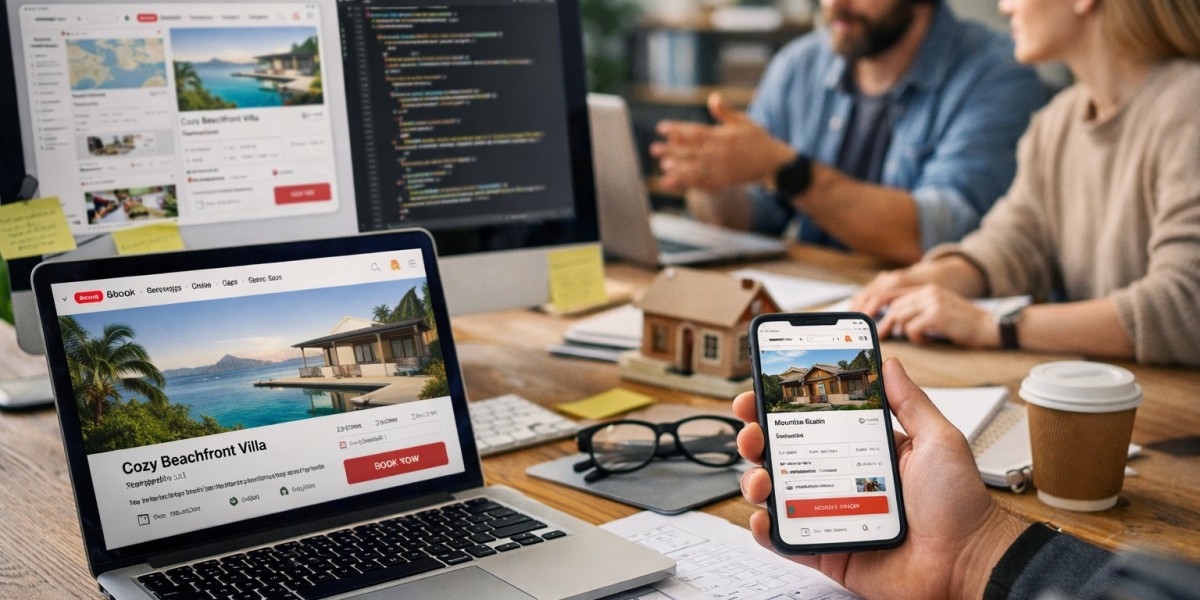
An Airbnb-style platform is not just a “vacation rental app.” It is a two-sided marketplace that connects hosts (property owners/managers) with guests (travelers) while enabling discovery, booking, payments, identity verification, messaging, reviews, and support—all inside one product ecosystem.
When entrepreneurs ask how to build an Airbnb clone from scratch, what they usually mean is:
A platform with the same core user journeys as Airbnb
A similar trust-and-safety layer
A scalable booking engine
A modern web + mobile experience
A monetization model through commissions and service fees
The challenge is that Airbnb’s success is not only based on UI. It is built on a carefully designed marketplace engine where supply and demand can grow without breaking trust, performance, or compliance.
This is where Airbnb clone app development becomes a strategic product decision. If you build it properly, you can launch in one niche (like serviced apartments, luxury villas, or long-term stays) and scale into multiple property categories later.
Key Business Models and Marketplace Structures for an Airbnb-Style App
Before you write a single line of code, you must define your marketplace structure because it impacts architecture, database design, and monetization.
Common marketplace models
1) Commission-based model
You charge a percentage from hosts, guests, or both per booking. This is the most common and scalable model.
2) Subscription model for hosts
Hosts pay a monthly or yearly fee to list properties. This works better for property managers and professional hosts.
3) Featured listing / advertising model
Hosts pay to boost visibility. This can be an additional revenue stream.
4) Hybrid model
Commission + subscription + paid promotions.
Single-tenant vs multi-tenant expansion
If you plan to expand into multiple cities or countries, your system should support:
Multi-currency
Multi-language
Tax rules and invoice generation
Local payment methods
Region-based availability and policies
This affects everything from checkout to cancellation logic.
Essential User Roles and Their End-to-End Journeys
A successful Airbnb clone is built around user journeys, not screens.
Guest journey
Sign up / login
Browse listings and search filters
View listing details
Check availability
Select dates and guests
Book instantly or request booking
Pay securely
Message host
Check-in and stay
Leave review and rating
Get support if something goes wrong
Host journey
Register as host
Create listing with images, rules, pricing
Set availability calendar
Configure fees and policies
Receive booking request or instant booking
Accept/decline bookings
Communicate with guest
Manage cancellations and refunds
Receive payouts
Handle reviews
Manage multiple properties
Admin journey
Approve/reject listings (optional)
Manage users and roles
Manage payouts and commissions
Handle disputes and refunds
Monitor fraud and suspicious behavior
Moderate reviews
Analytics and reporting
Content management (pages, policies, FAQs)
Without these journeys mapped clearly, your product becomes a random set of features rather than a scalable marketplace.
Core Features You Must Build for a Competitive Airbnb Clone Platform
The fastest way to fail in this niche is building a “listing app” without the marketplace engine. A real product must include multiple feature layers.
Guest-side essential features
Account registration (email/phone/social login)
Profile management
Search with location, date, guest count
Filters (price, amenities, type, rating, rules)
Map-based listing exploration
Booking flow with transparent pricing
Secure payment
Booking history
Wishlist / saved listings
In-app chat with host
Review and rating system
Cancellation flow
Notifications (email, push, SMS)
Host-side essential features
Listing creation wizard
Photo upload and management
Calendar and availability control
Pricing rules (weekday/weekend/seasonal)
Minimum/maximum stay rules
Booking request management
Payout setup
Host dashboard with analytics
Host verification options
Multiple property management (for scaling)
Admin-side essential features
User and listing moderation
Commission and fee configuration
Booking management
Dispute management
Refund and cancellation controls
Support ticket dashboard
Role-based access for admin team
Reports and analytics
CMS for policies, blog, landing pages
The Booking Engine: The Most Important Part of Your Airbnb Clone
Most apps fail because they treat booking like a simple “reserve” button. In reality, booking is a complex system with edge cases.
Booking types
Instant booking
Request-to-book
Pre-approval workflows
Long-term booking requests
Split payments (optional)
Booking logic you must handle
Preventing double bookings
Blocking dates instantly on payment confirmation
Handling pending payment windows
Time zone issues for check-in/check-out
Booking modifications (date changes)
Cancellation policies and refund rules
Cleaning fee calculations
Guest service fees
Host payouts schedule
Taxes (VAT/GST/local occupancy taxes)
A strong booking engine is a must-have foundation in airbnb clone app development.
Search, Filters, and Ranking: How Users Actually Find Properties
Search is not a “nice-to-have.” It is the core conversion engine.
Search parameters to support
Location-based search (city, area, coordinates)
Date range search
Guest count and bedrooms
Property type (apartment, villa, hostel, etc.)
Amenities (WiFi, pool, parking, kitchen)
Price range and discounts
Cancellation policy type
Instant book filter
Accessibility features
Ranking factors to include
Price competitiveness
Review rating and count
Booking conversion rate
Host responsiveness
Listing completeness
Availability
Location relevance
Map-based search
Most modern users expect map-based exploration. This requires:
Geo-indexing (PostGIS or MongoDB geo queries)
Cluster rendering for performance
Fast pagination and caching
Payments, Payouts, and Commissions: Designing a Safe Money Flow
Payments are a critical part of your product credibility.
Guest payment flow
Payment authorization
Payment capture (immediate or delayed)
Service fee inclusion
Invoice generation
Refund processing
Host payout flow
Payout after check-in (or after checkout)
Payout hold for fraud prevention
Multiple payout methods
Payout status tracking
Payment gateway choices
Most Airbnb-style marketplaces use Stripe Connect or similar because it supports:
Split payments
Marketplace compliance
Host onboarding and KYC
Automated payouts
If you are targeting multiple countries, you must also consider local gateways.
Trust, Safety, and Verification: The Hidden Foundation of Airbnb-Style Apps
Airbnb succeeded largely because it built trust between strangers. Your platform must do the same.
Trust features you should implement
Email and phone verification
ID verification (optional but recommended)
Host verification badges
Guest verification badges
Review and rating authenticity rules
Fraud detection signals
Messaging moderation triggers
Dispute resolution workflows
Safety features
Emergency contact option
Support access inside booking details
Host rules and house policy enforcement
Guest identity checks for high-risk bookings
Suspicious payment behavior monitoring
Without this layer, your platform will struggle to scale.
Technology Stack for Building an Airbnb Clone from Scratch
Your tech stack must match your product scale, team skills, and time-to-market goals.
Frontend (web)
React.js or Next.js for fast performance
Tailwind CSS or Material UI
Map integration (Google Maps, Mapbox)
Mobile apps
Flutter or React Native for cross-platform speed
Native iOS/Android for long-term optimization
Push notifications via Firebase
Backend
Node.js (Express/NestJS) for rapid iteration
Django for stability and fast development
Spring Boot for enterprise-grade architecture
Database
PostgreSQL for relational booking and payment data
PostGIS extension for location search
Redis for caching and sessions
Cloud infrastructure
AWS (EC2, S3, RDS, CloudFront)
Azure or Google Cloud alternatives
CDN for image delivery
Other must-have services
Object storage for property images
Email delivery (SendGrid, SES)
SMS provider (Twilio)
Analytics (Mixpanel, GA4)
Logging and monitoring (Datadog, Grafana)
A strong stack reduces bugs and prevents expensive rewrites later.
Step-by-Step Development Process to Build an Airbnb Clone from Scratch
A structured process is what separates a scalable product from a rushed MVP.
Step 1: Define your niche and launch strategy
Instead of competing with Airbnb globally, start with a focused niche:
Luxury villas in one region
Long-term rentals for students
Workation stays
Corporate serviced apartments
Religious tourism stays
Pet-friendly homes
A niche makes marketing easier and reduces product complexity.
Step 2: Create product requirements and workflows
Document:
User roles and permissions
Booking rules
Payment and payout rules
Cancellation policies
Commission model
Support workflow
Admin moderation flow
This is where most founders save months of rework.
Step 3: Build wireframes and clickable prototypes
Wireframes should cover:
Home and search
Listing detail page
Booking flow
Host dashboard
Admin dashboard
Prototypes help you validate user experience early.
Step 4: Design UI and brand identity
Your design must communicate:
Trust
Clean navigation
Simple booking
Professional hosting experience
Focus heavily on mobile usability because most bookings happen on mobile.
Step 5: Start backend architecture and database design
Key database entities:
Users
Roles
Listings
Listing images
Amenities
Availability calendar
Pricing rules
Bookings
Payments
Payouts
Reviews
Messages
Support tickets
If your database is weak, everything breaks later.
Step 6: Develop the guest experience first
Guest-side development should include:
Search and filters
Listing detail page
Booking and payment
Wishlist
Messaging
Reviews
This is the core revenue path.
Step 7: Develop the host dashboard
Hosts are your supply engine. You must make hosting simple:
Listing creation
Availability management
Booking management
Payout setup
Analytics
Step 8: Develop admin panel and moderation tools
Admin tools are essential for scaling. Your team must be able to:
Approve listings
Handle disputes
Manage refunds
Monitor fraud
Control platform fees
Step 9: QA testing and security testing
Testing must include:
Booking conflict testing
Payment success/failure handling
Refund scenarios
Load testing for search
Role-based access control testing
OWASP security checks
Step 10: Launch MVP and iterate using analytics
A marketplace is never “done.” Your first launch should focus on:
Stability
Booking conversion
Host onboarding
Customer support
Then iterate based on data.
How an Airbnb Clone Script Fits Into Your Build Strategy
Many entrepreneurs consider an airbnb clone script to speed up development. This can be useful, but only if you understand the tradeoffs.
What an airbnb clone script usually provides
Basic listing and booking modules
Guest and host accounts
Simple admin dashboard
Basic payment integration
Standard UI templates
What it usually lacks
Scalable search ranking
Advanced booking rules
Robust payout workflows
Fraud prevention and verification
Performance optimization
Multi-region compliance readiness
When a clone script is a smart choice
You need an MVP fast
You are validating market demand
You have a technical team to customize it
Your niche is simple (single region, limited rules)
When you should avoid it
You plan to scale internationally quickly
You need enterprise-level security
You require complex host management features
You want unique differentiators from day one
In many cases, founders start with a clone script and later rebuild. That’s why planning matters.
Designing a Scalable Database and Architecture for High Booking Volume
Airbnb-style apps are data-heavy. The platform must handle:
Thousands of listings
Millions of search queries
High concurrency booking attempts
Heavy image traffic
Real-time messaging
Recommended architecture approach
Modular monolith for MVP (fast and manageable)
Transition to microservices later if needed
Use caching aggressively for search and listing pages
Separate media storage from your app server
Use background queues for notifications and payouts
Scalability components to include early
Redis caching
CDN for listing images
Database indexing for search
Rate limiting for abuse prevention
Queue system for asynchronous tasks
Building these early reduces scaling disasters later.
Admin Controls and Marketplace Governance You Must Not Ignore
Marketplace apps are not self-running. Governance is a product feature.
Admin controls you need
Listing approval workflow
Host KYC review (optional)
Manual refund controls
Dispute escalation workflows
Review moderation rules
Fraud flags and account suspension
Commission adjustments for special cases
Customer support agent roles
A strong admin system reduces support costs and increases trust.
Legal, Compliance, and Policy Pages for Airbnb-Style Platforms
Even a small marketplace needs basic compliance.
Policies you should prepare
Terms of service
Privacy policy
Cancellation policy rules
Host rules and guest responsibilities
Refund policy
Cookie policy
Anti-discrimination policy
Compliance considerations
GDPR for EU users
Data retention rules
Payment compliance (PCI through gateway)
KYC requirements for payouts in many regions
You do not need to overcomplicate this, but you must not ignore it.
Estimated Cost and Timeline to Build an Airbnb Clone from Scratch
Costs vary widely based on scope, t