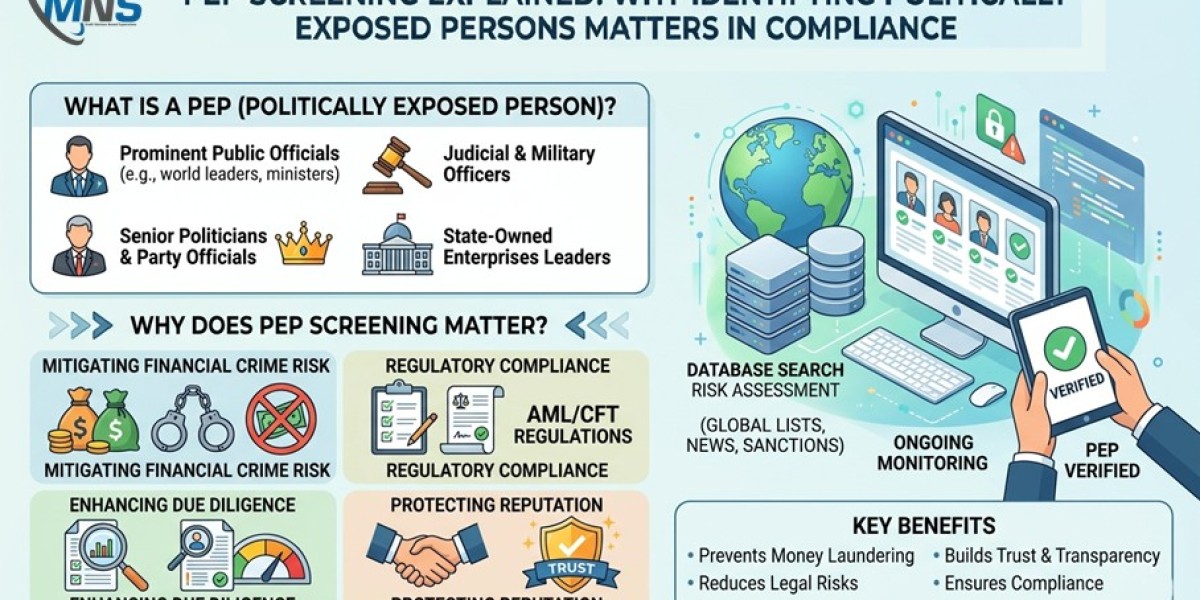
Compliance failures are no longer just a legal problem — they are an existential threat to businesses. Among the many components of a modern compliance framework, PEP Screening stands out as one of the most consequential. The identification and management of Politically Exposed Persons (PEPs) lies at the heart of effective Anti-Money Laundering (AML) and Know Your Customer (KYC) programmes.
This article explains PEP Screening in plain terms, explores why it matters so deeply for compliance teams, and outlines the regulatory obligations businesses face when dealing with Politically Exposed Persons in India and internationally.
Understanding Politically Exposed Persons in the Compliance Context
A Politically Exposed Person (PEP) is an individual who holds — or has recently held — a significant public position, making them potentially more susceptible to bribery, corruption, or abuse of their authority for personal financial gain. The term Politically Exposed Person is not a label of guilt; it is a risk classification that triggers higher levels of scrutiny.
Examples of Politically Exposed Persons include:
- Current or former heads of state, prime ministers, presidents
- Members of parliament, senators, or legislative assembly members
- Senior judges, including Supreme Court and High Court judges
- Senior military commanders
- Directors and senior executives of central banks
- Senior executives of state-owned enterprises and public sector undertakings
- Senior party officials of major political parties
- Senior officials of international organisations (UN, IMF, World Bank)
Compliance Alert Compliance teams must also screen Relatives and Close Associates (RCAs) of PEPs. These include spouses, children, parents, siblings, and business partners who may be used to hold or move funds on behalf of the primary PEP. |
The Compliance Case for PEP Screening
1. AML/CFT Regulatory Requirements
The Financial Action Task Force (FATF) — whose 40 Recommendations form the backbone of global AML/CFT frameworks — explicitly requires member countries to implement laws mandating enhanced due diligence for Politically Exposed Persons. India, as a FATF member, has embedded these requirements into the PMLA and the RBI's KYC Master Directions.
Failing to screen for PEPs is a direct violation of these obligations and can attract regulatory sanctions, licence suspension, or criminal liability.
2. Prevention of Money Laundering
PEPs are attractive targets for financial criminals precisely because their positions provide access to public funds, contracts, and regulatory decisions. Corrupt PEPs often seek to launder the proceeds of corruption through apparently legitimate business channels — making businesses that fail to conduct adequate PEP Screening unwitting participants in money laundering.
3. Bribery and Corruption Risk
Entering into business relationships with PEPs without proper compliance controls can expose organisations to bribery risk. Anti-corruption laws — including India's Prevention of Corruption Act, the UK Bribery Act, and the US Foreign Corrupt Practices Act (FCPA) — impose liability on companies as well as individuals. Robust PEP Screening is a key defence.
4. Sanctions Compliance
Many PEPs are also subject to international sanctions. Without PEP Screening integrated with sanctions list checking, businesses may inadvertently transact with sanctioned individuals — triggering severe penalties under US OFAC regulations, EU sanctions regimes, or PMLA provisions.
How PEP Screening Integrates into the Compliance Framework
PEP Screening does not operate in isolation. It is a critical component of the broader compliance ecosystem:
Compliance Process | Role of PEP Screening |
Customer Due Diligence (CDD) | Identifies PEP status at onboarding; determines appropriate risk tier |
Enhanced Due Diligence (EDD) | Triggered when PEP status is confirmed; involves deeper verification |
Ongoing Monitoring | Re-screens customers periodically; flags status changes in real time |
Transaction Monitoring | PEP status elevates the scrutiny applied to transaction patterns |
Suspicious Activity Reporting (SAR/STR) | Confirmed PEP with unusual transactions may require regulatory reporting |
Risk Appetite Management | Defines which PEP categories the business will accept or decline |
The Regulatory Landscape for PEP Screening in India
India has significantly tightened its AML/CFT compliance framework. Key regulations governing PEP Screening include:
Prevention of Money Laundering Act (PMLA), 2002
The PMLA is India's primary AML legislation. Reporting entities under the PMLA — including banks, financial institutions, NBFCs, insurance companies, and securities intermediaries — are required to conduct enhanced due diligence on PEPs and maintain records of all PEP relationships.
RBI Master Direction on KYC (2016, as amended)
The RBI's KYC Master Directions specifically require regulated entities to identify and maintain records of Politically Exposed Persons. For foreign PEPs, senior management approval is required before establishing or continuing a business relationship. Institutions must also take reasonable measures to determine whether a customer is a close relative or associate of a PEP.
IRDAI AML/CFT Guidelines
The Insurance Regulatory and Development Authority of India (IRDAI) mandates that insurance companies integrate PEP screening into their KYC and AML compliance programmes — applicable both at policy issuance and claim settlement.
SEBI KYC Guidelines
Market intermediaries regulated by SEBI are required to include PEP screening in investor KYC processes. This covers stockbrokers, mutual fund distributors, portfolio managers, and investment advisers.
Regulatory Reality The consequences of PEP compliance failures in India can include financial penalties, licence cancellation, and referral to the Enforcement Directorate (ED) or Central Bureau of Investigation (CBI) for investigation under PMLA. |
Building an Effective PEP Screening Compliance Programme
Compliance teams seeking to strengthen their PEP Screening programmes should focus on the following building blocks:
Risk-Based Approach
A risk-based approach (RBA) means applying proportionate levels of due diligence based on assessed risk — not treating all PEPs identically. A low-level local official in a low-corruption-risk country requires less scrutiny than a senior minister in a high-risk jurisdiction.
Clear PEP Definition and Policy
Organisations need to establish a clear internal policy defining who qualifies as a PEP, which categories of RCAs are in scope, what EDD is required, and what senior management oversight applies. This policy should be reviewed regularly as regulatory guidance evolves.
Technology and Data Quality
Manual PEP screening is inadequate for the volume and complexity of modern compliance obligations. Effective PEP Screening requires access to comprehensive, regularly updated PEP databases — either commercial platforms or curated from government sources and trusted media. Automated name-matching with fuzzy logic reduces both false positives and false negatives.
Training and Awareness
Compliance is ultimately a people discipline. Staff involved in customer onboarding, relationship management, and transaction processing must understand what Politically Exposed Persons are, why they require enhanced scrutiny, and how to handle PEP-related red flags appropriately.
Audit Trail and Documentation
Regulators expect compliance teams to demonstrate not just that PEP screening was done, but how it was done, by whom, and what decisions were taken. Every PEP screening decision — acceptance, rejection, escalation — must be documented with a clear rationale.
Common Compliance Failures in PEP Screening
Failure Mode | Regulatory Risk | Recommended Control |
Not screening customers at all | Critical — direct PMLA violation | Mandatory PEP check at onboarding |
Screening only at onboarding, not ongoing | High — status changes missed | Continuous monitoring with real-time alerts |
Using a single, outdated database | High — significant coverage gaps | Multi-source PEP and adverse media data |
Failing to screen RCAs | High — indirect PEP exposure | Include family members and associates in scope |
Not documenting EDD decisions | Medium — audit failure risk | Mandatory documentation standards |
No senior management approval for PEPs | High — RBI/IRDAI requirements not met | Formal escalation and approval workflows |
PEP Screening Across Business Sectors
Banking and Financial Services
Banks are at the frontline of PEP Screening obligations. The RBI's KYC framework requires banks to maintain an enhanced profile for all PEP customers, with senior management oversight of PEP relationships and regular review of PEP accounts.
Insurance
Insurance companies — both life and non-life — face AML/CFT obligations under IRDAI guidelines. PEP screening applies at policy issuance, premium payment, and claims settlement.
Trade Credit and Vendor Finance
Businesses providing trade credit, vendor finance, or surety bonds face credit and compliance risks from PEP counterparties. A supplier or buyer with PEP exposure may face regulatory freezes, reputational damage, or operational disruption that translates directly into credit risk.
Real Estate and Professional Services
Real estate developers, lawyers, accountants, and other professionals handling high-value transactions face increasing regulatory obligations around PEP screening as governments crack down on professional service providers being used as conduits for corruption proceeds.
Frequently Asked Questions (FAQs)
Q1: Is PEP screening mandatory for all businesses in India?
It is mandatory for all reporting entities under the PMLA — including banks, NBFCs, insurance companies, and securities intermediaries. For non-reporting entities, PEP screening represents best practice for managing reputational and financial crime risk.
Q2: What happens if a current customer becomes a PEP?
Continuous monitoring is designed to detect exactly this situation. When an existing customer is identified as having become a PEP, the institution must upgrade their risk classification, apply EDD, seek senior management approval to continue the relationship, and increase transaction monitoring.
Q3: How is PEP screening different from sanctions screening?
PEP screening identifies politically exposed individuals for enhanced due diligence. Sanctions screening checks whether individuals or entities are subject to specific legal prohibitions on doing business. Both are required — and both should be integrated in a robust compliance programme.
Q4: Can a PEP be a low-risk customer?
Under a risk-based approach, a former PEP who left office many years ago in a low-risk jurisdiction, with transparent and explainable wealth, may be assessed as posing lower residual risk. However, the classification and rationale must be documented and approved at the appropriate authority level.
Conclusion
PEP Screening is one of the most consequential — and regulatory-intensive — elements of a modern compliance programme. Understanding who Politically Exposed Persons are, why they require special treatment, and how to screen for them effectively is essential for any business operating in regulated sectors. With India's AML/CFT enforcement environment intensifying, organisations that invest in robust, technology-enabled, risk-based PEP Screening programmes will be best placed to protect themselves from regulatory sanctions, financial crime, and reputational risk.