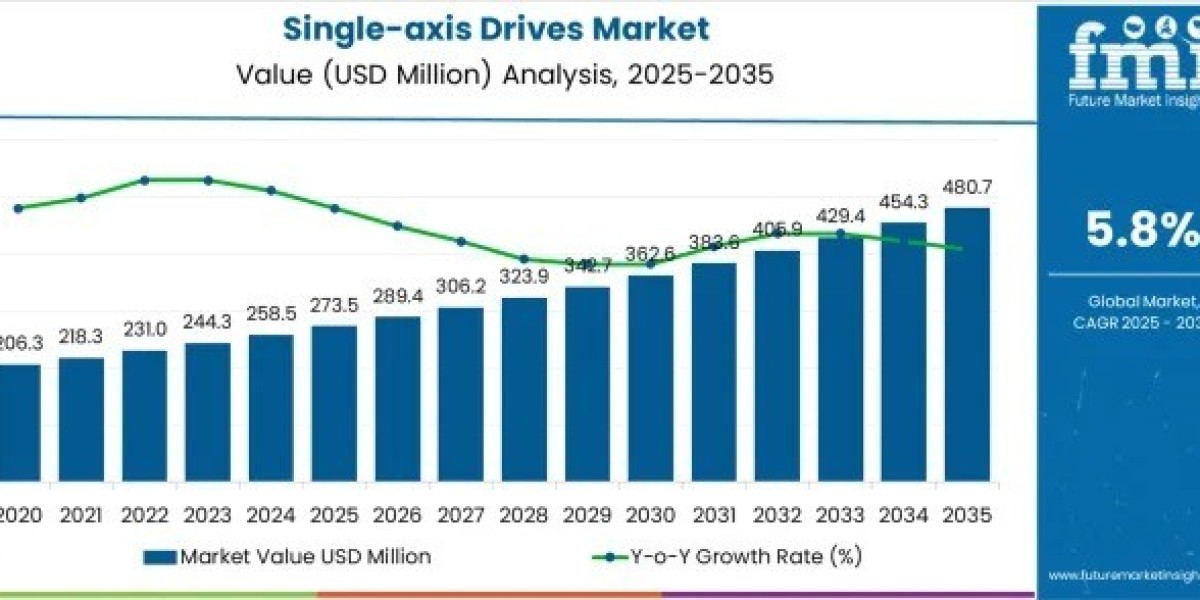
The Single-axis Drives Market is positioned for consistent expansion as industries worldwide accelerate automation and modernize manufacturing infrastructure. The market is forecast to grow from USD 273.5 million in 2025 to USD 480.7 million by 2035, reflecting a CAGR of 5.8% and an absolute growth of USD 207.2 million. This represents nearly 1.76x market expansion over the decade, underscoring the rising role of single-axis drives in precision-driven industrial environments.
Subscribe for Year-Round Insights → Stay ahead with quarterly and annual data updates
https://www.futuremarketinsights.com/reports/sample/rep-gb-27025
Key Growth Drivers Shaping Market Momentum
Market growth is being reinforced by structural shifts across industrial sectors where precision and repeatability directly impact productivity and quality.
Primary demand drivers include:
- Rapid adoption of automation technologies across manufacturing and logistics
- Rising need for high-precision positioning in semiconductor and electronics production
- Growing emphasis on operational reliability and yield optimization
- Integration of Industry 4.0 and intelligent motion control systems
Even minimal positioning inaccuracies can lead to costly rework or downtime, making advanced single-axis drives essential for modern production lines.
Market Value Expansion Across Forecast Phases
The growth trajectory of the market highlights increasing value creation in the latter half of the forecast period.
Value analysis insights:
- 2025–2030: Market expands from USD 273.5 million to USD 362.6 million
- Value addition of USD 89.1 million, accounting for 43% of total decade growth
- 2030–2035: Market grows further to USD 480.7 million
- Additional USD 118.1 million generated, representing 57% of total growth
This acceleration reflects deeper penetration of intelligent servo control, smart feedback systems, and advanced automation architectures.
Segmental Insights: Technology and Application Leadership
By Drive Type: Ball Screw Driven Systems Dominate
Ball screw driven single-axis drives account for approximately 53% of the market in 2025. Their leadership is driven by proven accuracy, high load-handling capability, and consistent performance across demanding applications.
Key advantages supporting adoption:
- High positioning accuracy and repeatability
- Reliability in heavy-load and high-precision environments
- Lower maintenance complexity compared to alternative technologies
These attributes make ball screw driven systems the preferred choice for semiconductor, medical, and precision machinery manufacturers.
By Application: Semiconductors Lead Demand
The semiconductor segment represents around 38% of total market demand, making it the largest application area.
Key demand factors include:
- Ultra-precise positioning requirements in wafer processing
- Need for consistent motion quality during extended production runs
- Focus on yield improvement and process automation
As global semiconductor capacity expands, demand for advanced motion control solutions remains structurally strong.
Regional Growth Dynamics Highlight Emerging Opportunities
Growth patterns vary significantly by geography, reflecting differences in industrial maturity and automation investment.
High-growth regions include:
- China: CAGR of 7.8%, driven by manufacturing expansion and semiconductor investments
- India: CAGR of 7.3%, supported by industrial infrastructure development and automation adoption
- Germany: CAGR of 6.7%, reflecting strong precision engineering standards and Industry 4.0 integration
Emerging markets in Latin America and the Middle East & Africa are also contributing incremental growth as industrial modernization programs advance.
Technology Trends Creating New Revenue Pathways
Innovation is reshaping single-axis drives from basic positioning units into intelligent motion solutions.
Key technology trends include:
- Smart drive integration with sensors and predictive diagnostics
- Modular designs enabling multi-application compatibility
- Advanced servo control and high-resolution encoders
- Energy-efficient operation supporting sustainable manufacturing goals
These advancements allow manufacturers to command premium pricing while delivering measurable operational benefits.
Competitive Landscape: Innovation and Expertise Drive Differentiation
The market remains competitive, with established motion control and automation companies investing in technology upgrades, application engineering, and regional expansion.
Leading players include:
- HIWIN, Aerotech, IAI, Rockwell Automation
- BOSCH Rexroth, Festo, Yamaha Motor, Yaskawa
- PI, CKD, NIKKI DENSO, Griffin Motion, and others
Strategic partnerships, localized support, and industry-specific solutions are central to strengthening market presence.