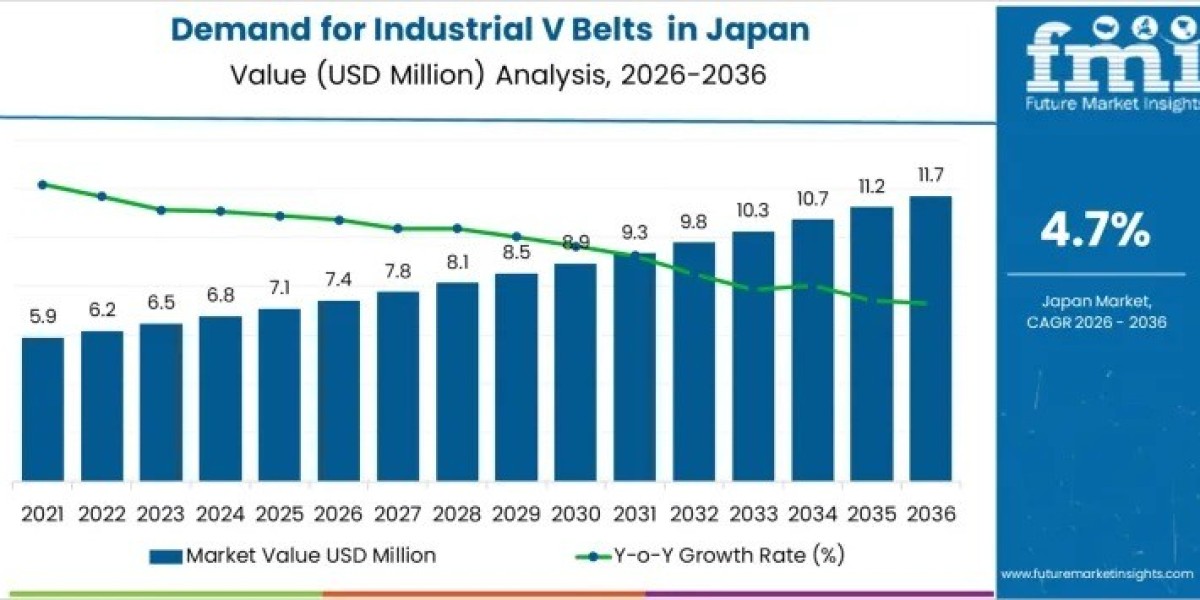
The Demand for Industrial V Belts in Japan is poised for steady growth, rising from USD 7.4 million in 2026 to USD 11.7 million by 2036, with a CAGR of 4.7%. This market expansion is largely maintenance-driven, reflecting the replacement cycles of belt-driven systems in automotive, food processing, pharmaceuticals, and consumer goods manufacturing. Early demand growth is tied to equipment uptime and predictable operational schedules rather than facility expansion.
Key Points:
- 2026 market value: USD 7.4 million
- Forecast 2036: USD 11.7 million
- CAGR: 4.7%
- Growth driven by replacement cycles and continuous operations in manufacturing facilities
Subscribe for Year-Round Insights → Stay ahead with quarterly and annual data updates:
https://www.futuremarketinsights.com/reports/sample/rep-gb-30065
Market Growth Outlook: 2026–2036
- 2026–2031: Growth from USD 7.4M to USD 8.9M
- Annual increment: ~USD 0.3M
- Driven by replacement in conveyors, pumps, compressors, and packaging machinery
- Small and mid-sized factories contribute steady maintenance-led demand
- 2031–2036: Growth to USD 11.7M
- Annual increment: ~USD 0.6M
- Fueled by modernized production lines, higher equipment density, and engineered machinery adoption
- Expansion reflects predictive maintenance and performance-driven procurement
Key Points:
- Early growth guided by scheduled maintenance cycles
- Later growth driven by automation and production modernization
- Market reflects stability and low volatility
Product and Application Dynamics
Narrow type industrial V belts account for approximately 65% of total demand, favored for their compact design, high transmission efficiency, and suitability for space-constrained machinery. These belts dominate applications in automotive systems, light manufacturing equipment, and auxiliary drives, where alignment tolerance and reduced mechanical losses are essential.
Automotive applications represent nearly 30% of total demand. Despite gradual electrification, internal combustion and hybrid vehicles continue to rely on V belts for alternators, air conditioning systems, and accessory drives. Stable vehicle parc size and routine servicing ensure repeat procurement through OEM and aftermarket channels, reinforcing demand resilience through 2036.
Regional Performance Reflects Industrial Distribution
- Kyushu & Okinawa: CAGR 5.9%, driven by food processing, packaging, and agricultural equipment
- Kanto: CAGR 5.4%, supported by electronics, automotive, and HVAC systems
- Kansai: CAGR 4.8%, fueled by machinery fabrication, textiles, and beverage production
- Chubu: CAGR 4.2%, supported by automotive production and machining centers
- Tohoku: CAGR 3.7%, agricultural processing and small-scale facilities
- Rest of Japan: CAGR 3.5%, small workshops and local production units
Reliability, Not Disruption, Shapes Demand
Japan’s industrial landscape continues to rely on aging yet dependable equipment fleets. Many factories operate belt-driven mixers, blowers, conveyors, and pumps that remain cost-effective and easy to maintain. Preventive maintenance practices replace belts before failure, minimizing downtime and preserving process consistency. Increasing use of predictive maintenance tools is encouraging adoption of belts with longer service life, lower vibration, and improved energy efficiency—without fundamentally changing the role of V belts in mechanical systems.
Beyond large factories, steady background demand comes from HVAC installations in offices, hospitals, and schools, as well as agricultural equipment and community workshops. These applications value standardized belt sizes, predictable wear behavior, and readily available stock, further stabilizing year-round consumption.
Competitive Landscape and Buyer Preferences
Key players such as Mitsuboshi Belting Ltd., Bando Chemical Industries Ltd., PIX Transmissions Ltd., SKF Group, and Dunlop Belting Products shape Japan’s supply ecosystem. Buyer decisions emphasize dimensional stability, heat resistance, tensile strength, and quiet operation under continuous duty. Local stocking capability, technical support, and alignment with Japanese industrial standards remain critical differentiators.
As manufacturers balance modernization with lifecycle extension of existing assets, industrial V belts continue to serve as essential components in Japan’s manufacturing continuity strategy—supporting growth that is steady, predictable, and firmly rooted in operational discipline.
Key Players
- Mitsuboshi Belting Ltd.: Molded and wrapped V belts for conveyors, compressors, agricultural equipment
- Bando Chemical Industries Ltd.: High-strength belts for automotive OEMs and industrial maintenance
- PIX Transmissions Ltd.: Imported belts for specialized OEM applications
- SKF Group: Belt-related components supporting maintenance
- Dunlop Belting Products: Heavy-duty belts for niche industrial sectors