
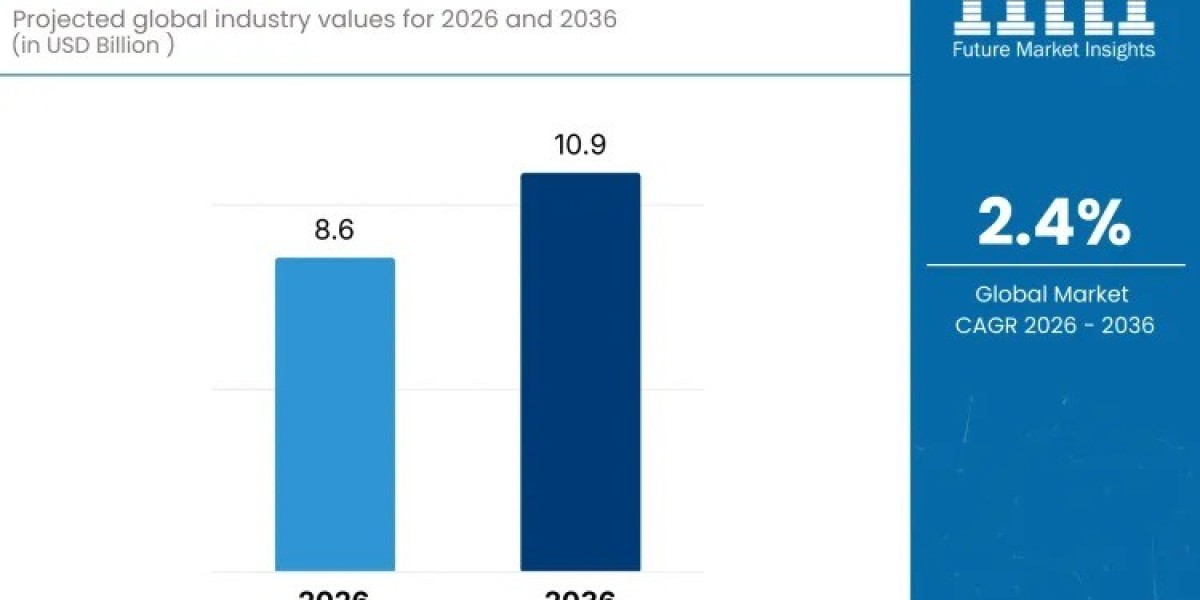
The global Urea Strippers Market is valued at USD 8.6 billion in 2026 and is projected to reach USD 10.9 billion by 2036, expanding at a value-based CAGR of 2.4%. Market growth is driven by steady expansion of urea production capacity, particularly in regions with strong agricultural demand and fertilizer consumption.
Unlike cyclical capital equipment markets, urea strippers benefit from consistent replacement and upgrade demand. These systems are critical in urea synthesis, enabling recovery of unreacted ammonia and carbon dioxide while supporting energy optimization and cost control in large-scale fertilizer plants. Growth during 2026–2036 is primarily supported by modernization of existing assets rather than aggressive greenfield expansion.
Subscribe for Year-Round Insights → Stay ahead with quarterly and annual data updates
https://www.futuremarketinsights.com/reports/sample/rep-gb-6536
Key Market Drivers Supporting Long-Term Demand
Urea strippers play a central role in improving conversion efficiency and reducing raw material losses in continuous urea production. Demand growth is reinforced by operational and regulatory pressures faced by fertilizer producers worldwide.
Primary growth drivers include:
- Modernization and replacement of aging stripping systems
- Rising efficiency targets to reduce energy consumption per ton of urea
- Need for reliable operation under high-pressure ammonia-carbamate conditions
- Incremental capacity additions aligned with regional agricultural demand
High-pressure and medium-pressure stripping technologies continue to dominate adoption due to their proven reliability and compatibility with large throughput plants.
Material of Construction Trends Reflect Lifecycle Cost Priorities
Material selection remains a critical purchasing criterion, directly impacting corrosion resistance, service life, and maintenance costs. Duplex steel accounts for approximately 45% of global demand, making it the leading material segment.
Material adoption insights:
- Duplex steel offers superior corrosion resistance and mechanical strength
- Longer operating life reduces maintenance downtime and lifecycle costs
- Stainless steel remains a cost-effective option for standard applications
- Exotic alloys such as zirconium and titanium address extreme corrosion environments
Material choices reflect the need to balance capital expenditure with long-term operational reliability.
Capacity Segmentation Highlights Mid-Scale Plant Dominance
By capacity, urea strippers designed for plants up to 1,000 MTPD hold the largest share at around 30% of global demand. These systems are widely adopted by medium-scale fertilizer producers serving regional agricultural markets.
Capacity-driven demand trends:
- Up to 1,000 MTPD units support decentralized fertilizer production
- 1,500–3,500 MTPD systems benefit integrated fertilizer complexes
- Above 3,500 MTPD units serve mega-scale, export-oriented plants
- Capacity selection reflects regional demand, investment strategy, and infrastructure maturity
Regional Analysis: Asia Pacific Leads, Emerging Regions Accelerate
Asia Pacific remains the largest demand center, led by China and India, due to extensive fertilizer manufacturing infrastructure and sustained agricultural input requirements. South Asia Pacific and Middle East & Africa show strong growth momentum, supported by new investments and fertilizer self-sufficiency programs.
Regional demand dynamics:
- Asia Pacific dominates due to scale and modernization initiatives
- Latin America benefits from expanding commercial agriculture
- Middle East & Africa see growth from new plant investments
- Europe and East Asia focus on efficiency upgrades and regulatory compliance
Regional trends are closely linked to crop demand, government policy, and industrial development levels.
Country-Level Growth Trends (2026–2036)
Demand growth varies by country, reflecting agricultural expansion and modernization intensity.
Projected CAGR highlights:
- Brazil: 3.7% CAGR, driven by large-scale agriculture and fertilizer self-sufficiency goals
- South Africa: 3.4% CAGR, supported by regional fertilizer demand and modernization
- Mexico: 3.1% CAGR, led by plant upgrades and environmental compliance
- Turkey: 2.9% CAGR, driven by industrial modernization and reduced import reliance
- Spain: 2.6% CAGR, reflecting steady upgrades in mature fertilizer facilities
Regulatory and Operational Constraints Shape Scalability
Market scalability is influenced by environmental regulations, capital intensity, and operational constraints. Compliance with emissions and energy efficiency standards increases engineering complexity and approval timelines. High-pressure operation requires specialized alloys and skilled technical personnel, raising upfront investment costs and limiting rapid scale-up.
Competitive Landscape: Engineering Expertise Defines Leadership
The global urea strippers market comprises 12–16 active players, with the top five controlling nearly 55–60% of total demand. Market leadership is defined by engineering depth, process optimization capability, and long-term service support.
Key players include:
- Larsen & Toubro
- Saipem S.p.A.
- Stamicarbon
- Urea Casale
- TOYO India
- Thyssenkrupp
- Images Heavy Engineering Ltd
- MANGIAROTTI spa
Competition is driven by materials science expertise, regulatory alignment, and the ability to deliver turnkey, high-reliability solutions.