
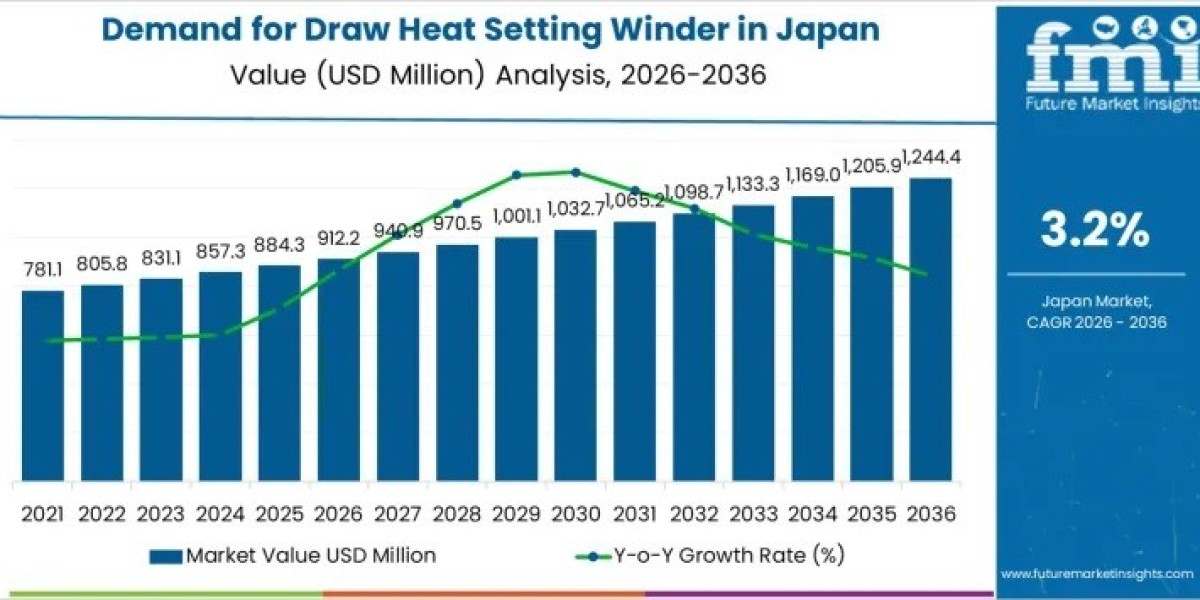
The Demand for Draw Heat Setting Winder in Japan is entering a phase of sustained, technology-led growth as textile manufacturers prioritize quality consistency, automation, and lifecycle upgrades. Valued at USD 912.2 million in 2026, the market is projected to reach USD 1,244.4 million by 2036, expanding at a CAGR of 3.2% over the forecast period.
This expansion builds on steady growth recorded between 2020 and 2026, when demand increased from USD 757.3 million to USD 912.2 million, supported by replacement of aging winding systems and modernization of fiber processing lines. Rather than cyclical spikes, the market reflects predictable annual gains aligned with Japan’s established textile production workflows.
Subscribe for Year-Round Insights → Stay ahead with quarterly and annual data updates
https://www.futuremarketinsights.com/reports/sample/rep-gb-29932
Automation Remains the Core Growth Driver
Automation continues to shape procurement decisions across Japanese textile facilities.
Key automation-driven trends include:
- Automatic winders account for ~60% of total demand, reflecting preference for uninterrupted operation and reduced manual handling
- Improved tension accuracy and thermal uniformity support consistent yarn properties
- Lower long-term labor and rework costs justify investment in advanced systems
Automatic draw heat setting winders are widely adopted in continuous production lines, where uptime and precision directly affect throughput. As mills focus on minimizing yarn variation and defects, automated systems are increasingly viewed as essential rather than optional.
Flat-Type Winders Lead by Design Preference
By type, flat-type winders represent approximately 45% of market demand, maintaining their position as the preferred configuration for Japanese textile producers.
Why flat-type winders dominate:
- Uniform package formation supports high-speed weaving and knitting
- Reduced snarling and predictable unwinding behavior
- Strong suitability for fine-denier yarns and technical textiles
These systems are particularly valuable in applications requiring tight quality tolerances, where consistent winding geometry directly influences downstream performance.
Growth Forecast Highlights Stronger Momentum Post-2031
Market progression accelerates in the second half of the forecast period.
Growth outlook by phase:
- 2026–2031: Market expands from USD 912.2 million to USD 1,032.7 million
- Driven by equipment replacement and targeted process upgrades
- 2031–2036: Demand rises further to USD 1,244.4 million
- Supported by deeper automation, advanced fault detection, and technical yarn production
Later-stage growth reflects strategic capital investment rather than maintenance spending, signaling confidence in long-term domestic textile competitiveness.
Expanding Applications Support Equipment Demand
Draw heat setting winders play a critical role in producing yarns used across multiple high-value textile segments.
Key application drivers include:
- Automotive fabrics requiring dimensional stability
- Medical textiles and filtration materials with precise performance criteria
- Engineered films and sportswear demanding uniform thermal treatment
Buyers increasingly assess machines based on:
- Energy efficiency
- Digital control systems
- Compatibility with Industry 4.0-enabled production environments
This shift aligns equipment demand with Japan’s move toward specialized, higher-margin textile outputs.
Regional Demand Reflects Established Textile Clusters
Regional textile ecosystems strongly influence adoption patterns.
Regional growth highlights:
- Kyushu & Okinawa: Fastest growth at 3.9% CAGR, supported by efficient winding upgrades
- Kanto: 3.6% CAGR driven by dense industrial and technical textile clusters
- Kansai: Stable 3.2% CAGR reflecting mature textile operations
- Chubu & Tohoku: Moderate growth led by replacement demand
Local production routines—such as polyester filament stabilization in Fukui and shrinkage control in Ishikawa—create steady regional pull for draw heat setting winders.
Competitive Landscape Shaped by Precision and Reliability
The Japanese market favors suppliers capable of delivering stable tension control, uniform heat distribution, and compact designs suitable for space-constrained facilities.
Key suppliers include:
- Sapru Machine
- QingDao HongDA Textile Machinery Co., Ltd
- Himson Engineering Pvt. Ltd
- Xindawei Textile Machinery Co., Ltd
- Wuxi Xindawei Textile Machinery Co., Ltd
Equipment selection emphasizes repeatable package density, low yarn breakage rates, energy efficiency, and seamless integration with draw frames and texturing units.
Strategic Outlook
Japan’s draw heat setting winder market reflects measured industrial growth, driven not by volume expansion but by precision, automation, and quality leadership. As textile producers align machinery investment with advanced yarn applications and export-oriented production, demand for reliable, automated winding solutions remains structurally strong.