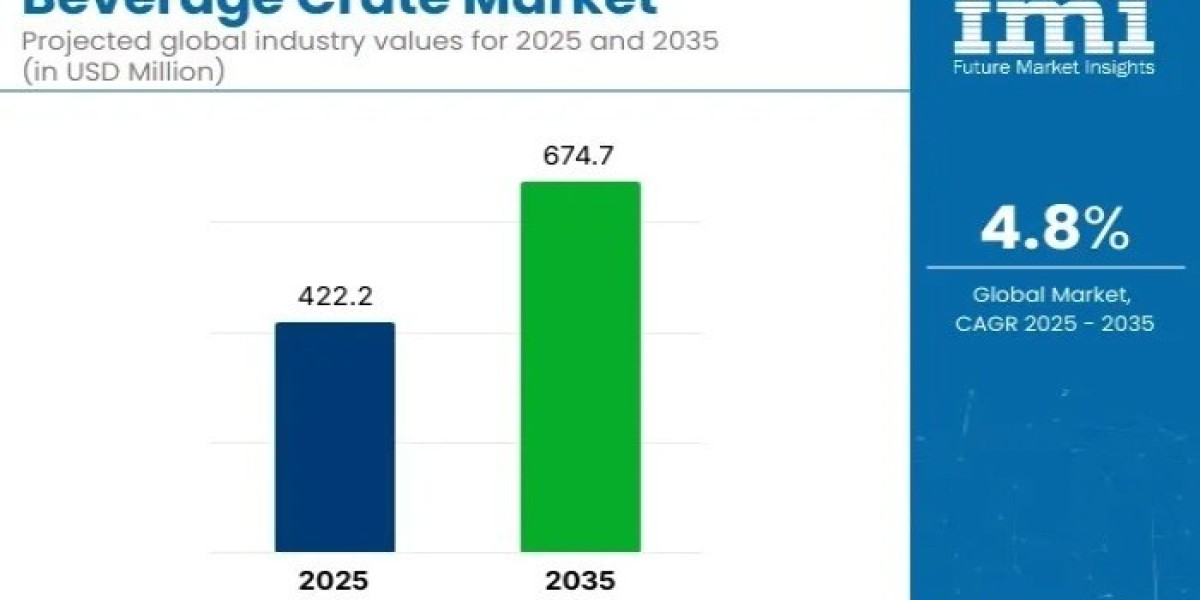
The global beverage crate market is entering a decade of steady expansion, driven by sustainability reforms, heightened beverage consumption, and innovations in reusable packaging solutions. According to recent industry analysis, the market is set to grow from USD 422.2 million in 2025 to USD 674.7 million by 2035, reflecting a CAGR of 4.8%. In 2024, sales reached USD 407.9 million, showcasing the sector’s resilience amid shifting regulatory, consumer, and supply-chain dynamics.
As beverage manufacturers worldwide transition towards durable, eco-friendly logistics packaging, beverage crates—known for their reusability, structural integrity, and cost efficiency are becoming indispensable across breweries, soft drink plants, and distribution networks.
Subscribe for Year-Round Insights → Stay ahead with quarterly and annual data updates – https://www.futuremarketinsights.com/reports/sample/rep-gb-6585
Innovation Takes Center Stage: Tetra Pak & Schoeller Allibert Lead the Way
One of the most influential developments shaping the decade ahead is the breakthrough collaboration between Tetra Pak and Schoeller Allibert. In April 2025, at the Plastics Recycling Show in Amsterdam, the companies unveiled a next-generation transport crate made from polyAl, a recycled material extracted from used beverage cartons.
Britta Wyss Bisang, VP Sustainability & Strategic MarCom at Schoeller Allibert, highlighted the urgency for innovation in materials:
This innovation marks a pivotal step toward high-performance crates made from recycled inputs—ushering in an era of greener packaging solutions.
Market Dynamics: Sustainability, Technology & High-Frequency Beverage Distribution
Growing demand for lightweight, recyclable, and resilient packaging is transforming the beverage crate industry. Manufacturers are investing in:
- Recycled and bio-based materials
- RFID-enabled traceability solutions
- Ergonomic and modular crate designs
- Smart manufacturing automation
Such advancements align with global sustainability mandates and strengthen the business case for reusable packaging systems.
The market is also receiving strong traction from breweries, dairy producers, and soft drink manufacturers who increasingly rely on crate-based closed-loop systems to ensure safety, reduce breakage, and cut long-term logistics costs.
Semi-Annual Growth Snapshot
Industry projections for semi-annual growth (CAGR) indicate steady upward momentum:
The market experienced a 90 BPS dip in H1 and a 90 BPS rise in H2, reflecting shifts in raw material pricing, sustainability adoption, and manufacturing investments.
Investment Spotlight: HDPE Leads Material Preference
High-Density Polyethylene (HDPE) is expected to dominate the market with 67.8% share in 2025 thanks to its:
- Exceptional strength-to-weight ratio
- High durability under repeated use
- Compatibility with recycled resin
- Resistance to chemicals, moisture, and UV exposure
HDPE crates support automated warehouse operations, last hundreds of cycles, and increasingly incorporate recycled inputs—solidifying their position as the top choice for global crate manufacturers.
Application Highlight: Non-Alcoholic Beverage Segment Leads Demand
The non-alcoholic drinks segment is projected to command 41.2% market share in 2025, driven by:
- Rising consumption of bottled water, juices, dairy, tea, and carbonated drinks
- Frequent, high-volume distribution cycles
- Urban retail and institutional supply chains
- Growing adoption of refillable packaging
Enhanced stacking, ergonomic handling, and brand customization continue to make crate systems indispensable across supermarkets, schools, hospitals, and commercial channels.
Regional Trends & Country Outlook
Global growth from 2025–2035 will be propelled by sustainability mandates, supply-chain modernization, and price-sensitive markets shifting to reusable crates.
Country Growth Forecasts (CAGR 2025–2035)
- India: 5.9%
- China: 5.7%
- Spain: 4.4%
- USA: 3.8%
- Canada: 3.5%
- Germany: 3.5%
In the USA, the booming craft beer sector is creating heightened demand for durable, brewery-specific crate solutions. Germany’s longstanding Pfandsystem continues to drive adoption of reusable crates in a highly regulated, circular packaging environment.
Market Structure: Tiered Competitive Landscape
- Tier 1 Players (global leaders): Brambles Limited, Schoeller Allibert, DS Smith, Rehrig Pacific
- Tier 2 Players (regional specialists): Supreme Industries, IPL Plastics, Craemer UK
- Tier 3 Players (local manufacturers): Numerous SMEs fulfilling niche and region-specific needs
These companies are expanding through smart crates, recycled materials, lightweight designs, and rapid customization technologies.
Recent Industry Moves
- Carlsberg’s USD 3.3B acquisition of Britvic (2025) strengthens synergy between beer and soft drink distribution.
- Coca-Cola’s acquisition of Billson’s (2024) expands its presence in Australia’s ready-to-drink alcoholic beverage segment.
These mergers intensify demand for robust crate solutions supporting multi-beverage portfolios.
Why FMI: https://www.futuremarketinsights.com/why-fmi
About Future Market Insights (FMI)
Future Market Insights, Inc. (FMI) is an ESOMAR-certified, ISO 9001:2015 market research and consulting organization, trusted by Fortune 500 clients and global enterprises. With operations in the U.S., UK, India, and Dubai, FMI provides data-backed insights and strategic intelligence across 30+ industries and 1200 markets worldwide.