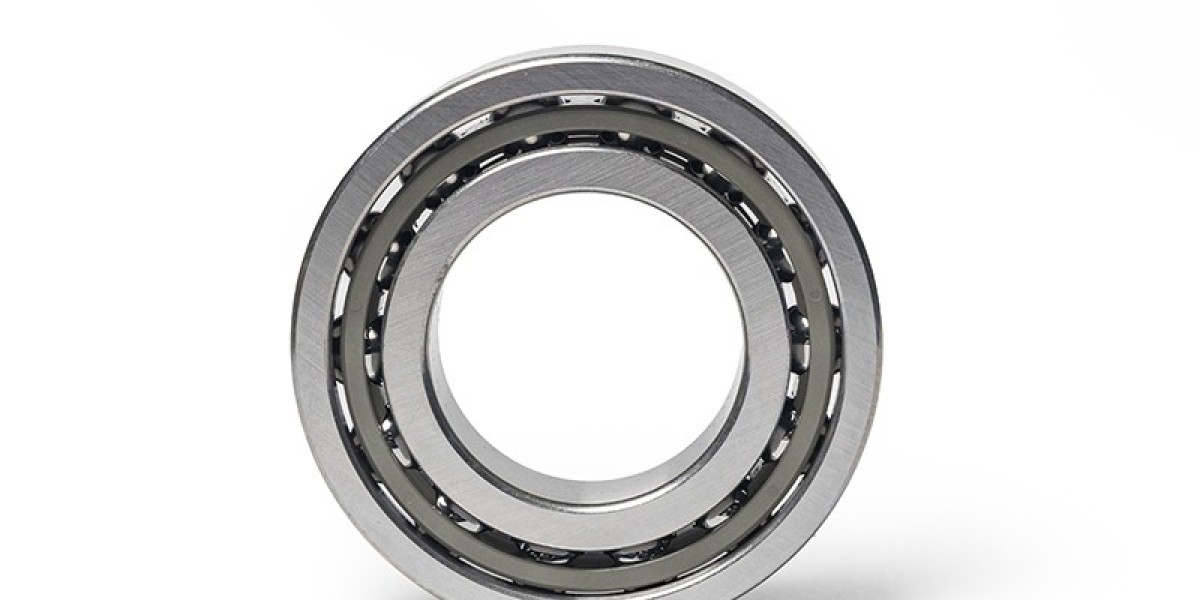
Modern industrial machines often struggle with high axial loads, vibration, and premature bearing failure. In heavy cutting, high-pressure pumps, and transmission systems, standard bearings lose accuracy under stress.
The 72 angular contact ball bearing is designed to handle higher axial forces while maintaining precision and stability in demanding environments.
The Industry Problem – High Axial Loads and Reduced Stability
In many manufacturing plants, machines operate under combined radial and axial loads. Common issues include:
Spindle deflection during heavy cutting
Bearing overheating
Excessive vibration
Reduced surface finish quality
Shortened bearing life
Deep groove ball bearings or improperly selected angular bearings often cannot maintain rigidity under heavy thrust loads.
The Solution – What Is a 72 Angular Contact Ball Bearing?
The 72 angular contact ball bearing is a single-row angular contact bearing with a larger contact angle compared to the 70 series.
This design allows it to support significantly higher axial loads while still managing radial forces efficiently.
It is widely used in high-load, high-speed industrial applications where rigidity is critical.
How the 72 Angular Contact Ball Bearing Works
The bearing’s larger contact angle increases axial load capacity. When force is applied:
Axial loads are distributed along the contact angle
Radial loads are supported simultaneously
Friction is optimized for high-speed rotation
Preload improves stiffness and positioning accuracy
When installed in paired arrangements (back-to-back or tandem), it can support bidirectional axial loads and enhance system rigidity.
This makes it ideal for heavy-duty spindle systems.
Problems with Traditional Bearing Solutions
Many facilities use standard deep groove bearings or smaller contact angle bearings in heavy-load systems.
1. Insufficient Axial Load Capacity
Smaller contact angles cannot handle strong thrust forces.
2. Reduced Rigidity
Under heavy cutting or pressure, deformation affects precision.
3. Thermal Instability
Poor load distribution leads to excess heat.
4. Increased Maintenance Costs
Frequent replacements cause downtime and production loss.
These challenges directly impact manufacturing efficiency and product quality.
How 72 Angular Contact Ball Bearings Solve These Issues
The 72 series improves performance through:
Larger contact angle for higher thrust capacity
Precision-ground raceways for smooth rotation
High-strength bearing steel for durability
Controlled preload for improved rigidity
Optimized cage design for speed and heat control
These features help maintain alignment and accuracy even under heavy operating loads.
Key Features of 72 Angular Contact Ball Bearings
High Axial Load Capacity
Handles stronger thrust loads than 70 series bearings.
Improved Rigidity
Reduces shaft deflection and improves machining stability.
High-Speed Compatibility
Designed to perform reliably at elevated RPM.
Flexible Mounting Configurations
Available for DB, DF, or DT arrangements.
Long Service Life
Advanced material treatment improves fatigue resistance.
These characteristics make the 72 series suitable for precision and heavy-duty applications.
Comparison – 72 vs 70 vs Deep Groove Bearings
| Feature | 72 Angular Contact | 70 Angular Contact | Deep Groove |
|---|---|---|---|
| Contact Angle | Larger | Smaller | Minimal |
| Axial Load Capacity | Very High | High | Limited |
| Rigidity | Very High | High | Moderate |
| Speed Capability | High | Very High | Moderate |
| Ideal Application | Heavy-duty spindles | High-speed spindles | General machinery |
The 72 series is preferred when axial load capacity and stiffness are more important than extreme speed.
Real Industrial Applications
72 angular contact ball bearings are commonly used in:
CNC machining centers
Heavy-duty milling machines
Industrial pumps
Compressors
Gearboxes
Automotive systems
These industries require reliable load handling and precise shaft positioning.
Why Manufacturers Prefer 72 Angular Contact Ball Bearings
Engineers and procurement managers select the 72 angular contact ball bearing because it:
Improves machining precision
Supports heavy axial forces
Reduces vibration under load
Extends spindle life
Lowers long-term maintenance costs
For OEM manufacturers, stable performance means consistent product quality and fewer production interruptions.
How to Choose the Right 72 Angular Contact Ball Bearing
Selecting the correct bearing ensures optimal results.
1. Determine Axial Load Requirements
Evaluate thrust force in your application.
2. Choose Precision Grade
Higher accuracy classes are essential for CNC machines.
3. Select Proper Arrangement
Back-to-back increases rigidity; tandem supports higher loads.
4. Consider Operating Speed
Ensure compatibility with required RPM.
5. Check Lubrication Method
Grease or oil-air systems affect temperature and durability.
Working with a reliable supplier ensures correct technical selection.
Conclusion
In heavy industrial environments, bearing selection directly impacts equipment performance. Standard bearings often fail under strong axial loads, causing vibration and reduced accuracy.
The 72 angular contact ball bearing provides superior thrust capacity, rigidity, and long-term reliability. For manufacturers seeking stable, high-load spindle performance, it is a smart and cost-effective investment.