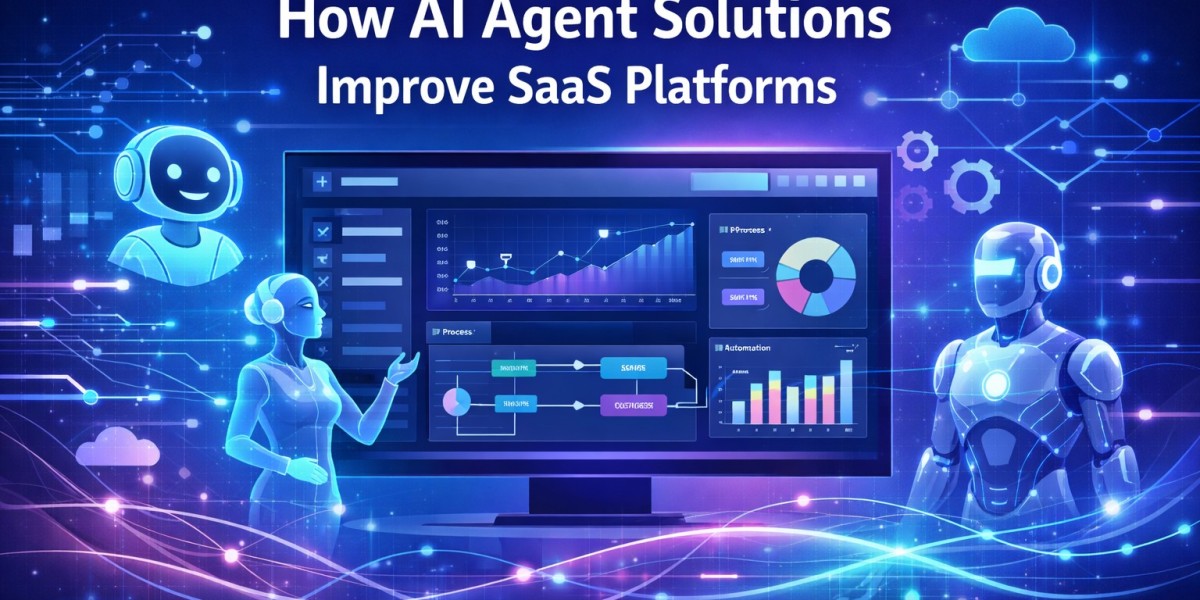
Software-as-a-Service (SaaS) has redefined how businesses access and use technology. Instead of installing heavy software systems, organizations now subscribe to flexible, cloud-based platforms that evolve continuously. But while SaaS delivery models have matured, user expectations have grown even faster.
Today’s users don’t just want dashboards and reports. They expect intelligent recommendations, automated workflows, predictive alerts, and personalized experiences. In other words, they expect software that thinks.
This is where AI agent solutions are changing the game. AI agents bring autonomy, adaptability, and real-time decision-making into SaaS platforms, transforming them from passive tools into proactive business partners. Let’s explore how AI agent solutions improve SaaS platforms—and why forward-thinking companies are prioritizing them.
The Evolution of SaaS: From Tools to Intelligent Systems
In its early stages, SaaS was primarily about accessibility and scalability. Businesses moved from on-premise installations to cloud-hosted solutions, gaining flexibility and lower infrastructure costs. Over time, SaaS platforms added analytics dashboards, automation workflows, and integrations.
However, traditional automation has limitations. It works based on predefined rules. If X happens, then trigger Y. While useful, this rule-based approach cannot adapt to unexpected scenarios or evolving user behavior.
AI agents go beyond rule-based automation. They analyze data patterns, learn from user interactions, make contextual decisions, and continuously improve performance. Instead of waiting for user commands, AI agents anticipate needs and act proactively.
This shift marks the next major evolution of SaaS platforms—from reactive systems to intelligent ecosystems.
What Are AI Agent Solutions?
AI agents are autonomous digital systems that perceive inputs, process information, and take goal-oriented actions. In a SaaS context, these agents can operate across various functions such as customer support, analytics, workflow management, and sales optimization.
Unlike simple chatbots, AI agents can:
- Interpret complex queries
- Access and analyze multiple data sources
- Trigger automated actions across systems
- Learn from feedback
- Adapt to changing environments
Some advanced solutions also leverage generative AI to create content, draft responses, summarize reports, or generate predictive insights in real time. This combination of autonomy and creativity makes AI agents especially powerful within SaaS environments.
Enhancing User Experience Through Personalization
One of the biggest advantages of AI agent solutions in SaaS platforms is personalized user experience.
Traditional SaaS dashboards look the same for every user. AI agents, however, can analyze user behavior, feature usage patterns, and interaction history to customize interfaces and recommendations.
For example, in a CRM SaaS platform, an AI agent can:
- Highlight high-priority leads
- Recommend follow-up actions
- Suggest optimal communication timing
- Provide personalized sales insights
This level of personalization reduces friction, improves productivity, and increases user satisfaction.
Over time, the AI agent becomes more aligned with the user’s workflow, essentially acting as a digital assistant embedded within the platform.
Intelligent Customer Support and Self-Service
Customer support is often one of the most resource-intensive areas for SaaS companies. AI agent solutions dramatically reduce support burdens while improving response quality.
Instead of static FAQ pages, AI-powered agents can:
- Understand natural language queries
- Provide contextual answers based on account data
- Troubleshoot issues step-by-step
- Escalate complex cases intelligently
By integrating generative AI capabilities, support agents can craft more human-like responses and adapt tone based on the customer’s sentiment.
This not only reduces operational costs but also enhances customer satisfaction through faster and more accurate assistance.
Proactive Insights and Predictive Analytics
One of the defining features of AI agent solutions is predictive intelligence. Rather than simply displaying historical data, AI agents analyze trends and forecast outcomes.
In a SaaS analytics platform, an AI agent might:
- Predict churn risks
- Identify revenue growth opportunities
- Detect unusual user behavior
- Alert teams about performance anomalies
These predictive insights empower businesses to act before problems escalate. For example, if an AI agent detects declining engagement from a key account, it can notify the customer success team and suggest intervention strategies.
This proactive approach strengthens customer retention and improves long-term revenue stability.
Automating Complex Workflows
Automation is not new to SaaS platforms. However, traditional automation often relies on rigid workflows. AI agents introduce adaptive automation.
Consider a project management SaaS tool. An AI agent can:
- Analyze task delays
- Recommend resource reallocation
- Adjust timelines dynamically
- Send automated reminders based on urgency
In finance SaaS platforms, AI agents can detect anomalies in expense reports, flag suspicious transactions, and even draft compliance summaries.
Because AI agents continuously learn from system data, their automation logic becomes smarter over time. This reduces manual oversight and allows teams to focus on strategic initiatives.
Improving Product Adoption and User Onboarding
Many SaaS platforms struggle with feature adoption. Users often utilize only a fraction of available capabilities.
AI agents can serve as onboarding guides. By observing user behavior, they can recommend features, provide contextual tutorials, and offer interactive walkthroughs tailored to each user’s needs.
For example, if a user frequently exports reports manually, the AI agent might suggest automation features within the platform. If a new user hesitates on a specific dashboard, the agent can provide guidance in real time.
This personalized onboarding accelerates user proficiency and increases platform stickiness.
Strengthening Data-Driven Decision Making
SaaS platforms generate enormous volumes of data. Yet many users lack the expertise to interpret it effectively.
AI agents bridge this gap by translating complex analytics into actionable insights. Through conversational interfaces, users can ask questions like:
- “What caused the drop in conversions last week?”
- “Which marketing channel delivered the highest ROI?”
- “What are the projected sales for next quarter?”
The AI agent processes the query, analyzes the data, and presents a clear explanation.
This democratization of analytics ensures that decision-making is no longer limited to data specialists.
Seamless Integration Across Ecosystems
Modern SaaS platforms rarely operate in isolation. They integrate with payment gateways, CRM systems, marketing tools, and communication platforms.
AI agent solutions must be designed to work across this ecosystem. Effective AI integration services ensure smooth connectivity between the AI layer and existing systems.
Without proper integration, AI agents cannot access the data they need to function effectively. Seamless connectivity allows agents to trigger actions across platforms, enhancing operational efficiency.
For SaaS companies looking to implement intelligent features, partnering with a reliable AI development company can streamline this integration process and reduce technical risks.
Competitive Differentiation in a Crowded Market
The SaaS market is highly competitive. Features that were once considered innovative quickly become standard.
AI agent solutions offer a powerful differentiator. A SaaS platform that provides proactive recommendations, automated insights, and conversational intelligence stands out from competitors offering static dashboards.
Businesses that invest in AI agent Development services can create smarter platforms that deliver measurable value to customers.
In many cases, companies choose to hire AI developers to build customized AI agents aligned with their product vision. This strategic investment strengthens product positioning and increases customer loyalty.
Enhancing Security and Risk Management
Security is a top concern for SaaS providers. AI agents can enhance security by monitoring unusual patterns, detecting potential breaches, and responding to threats in real time.
For instance, an AI agent can:
- Identify abnormal login behaviors
- Flag suspicious data exports
- Detect unusual transaction patterns
By acting instantly, AI agents reduce vulnerability windows and protect sensitive information.
This proactive risk management builds trust and strengthens brand reputation.
Driving Scalability and Operational Efficiency
As SaaS companies grow, manual processes become bottlenecks. AI agents enable scalable operations by handling repetitive tasks autonomously.
Whether managing thousands of support queries or analyzing millions of transactions, AI agents operate consistently and efficiently. Their ability to scale without proportional increases in staffing costs improves profitability.
Furthermore, AI-powered automation reduces human error, ensuring consistent service quality as the customer base expands.
The Role of Generative AI in SaaS Innovation
Generative AI has added a new dimension to SaaS platforms. Beyond analyzing data, generative models can create content, draft emails, generate reports, and even build code snippets.
For example, in a marketing SaaS platform, generative AI can produce campaign copy suggestions. In HR SaaS tools, it can draft job descriptions or summarize interview feedback.
When embedded within AI agent solutions, generative AI enhances productivity and creativity, transforming SaaS platforms into intelligent collaborators.
Implementation Considerations for SaaS Companies
While the benefits are compelling, implementing AI agent solutions requires strategic planning.
SaaS companies must evaluate:
- Data readiness and quality
- Infrastructure scalability
- Security requirements
- Long-term maintenance strategies
Collaborating with an experienced AI development company ensures structured deployment and continuous optimization.
Additionally, investing in AI integration services guarantees smooth alignment between AI agents and existing product architecture.
The Human-AI Balance
Despite their capabilities, AI agents are not meant to replace human expertise. Instead, they augment it.
Customer success teams, developers, and executives benefit from AI-generated insights but still provide strategic direction. The most successful SaaS platforms create synergy between human judgment and AI intelligence.
This balanced approach builds trust among users while maximizing innovation potential.
Conclusion
AI agent solutions are redefining what SaaS platforms can achieve. From personalized user experiences and predictive analytics to intelligent automation and enhanced security, AI agents transform software into proactive business partners.
In an increasingly competitive SaaS landscape, intelligence is the new standard. Companies that invest in AI agent Development services, leverage generative AI capabilities, and strategically hire AI developers position themselves for long-term growth.
Ultimately, AI-powered SaaS platforms are not just more efficient—they are more valuable, adaptable, and future-ready. Businesses that embrace this evolution today will lead tomorrow’s digital economy.