Industrial machinery today operates under increasing pressure for precision, speed, and continuous performance. Manufacturing systems, robotics, CNC equipment, and automation technologies all require highly stable rotational movement to maintain production quality and operational efficiency. However, many businesses continue facing problems such as vibration, positioning inaccuracies, rotational instability, and premature machine wear.
These issues often lead to unexpected downtime, product quality defects, and rising maintenance costs. In many industrial applications, the actual problem is not the machine itself but the bearing system responsible for supporting rotational accuracy and load stability.
This is why industries increasingly rely on RU cross roller bearing solutions. Designed for high rigidity and compact precision systems, RU cross roller bearings help improve machine stability, reduce vibration, and support highly accurate rotational performance under complex load conditions.
For B2B buyers, selecting the correct precision bearing is now a critical operational decision directly connected to manufacturing efficiency and long-term equipment reliability.
Why Standard Bearings Struggle in Precision Applications
Modern industrial systems often experience combined radial, axial, and moment loads simultaneously. Standard bearing configurations may not maintain sufficient rigidity or positioning accuracy under these demanding conditions.
As operational pressure increases, manufacturers commonly face problems such as:
- Rotational runout
- Positioning errors
- Excessive vibration
- Uneven load distribution
- Reduced machining accuracy
- Frequent maintenance interruptions
These issues become especially problematic in robotics, automation systems, semiconductor manufacturing, and high-precision CNC equipment where even small movement deviations can affect final production quality.
Traditional bearing systems also often require multiple bearing arrangements to support complex loads, increasing mechanical complexity and installation space.
RU cross roller bearings solve these problems through an integrated high-rigidity bearing structure capable of handling multiple load directions simultaneously.
What Makes RU Cross Roller Bearing Different
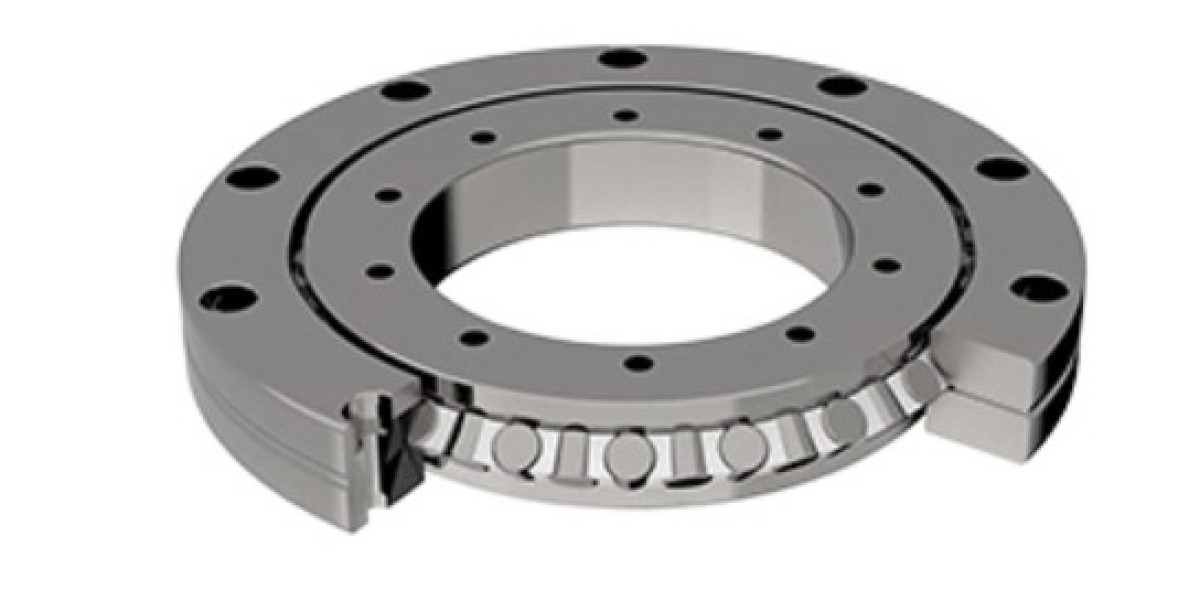
RU cross roller bearings are designed with cylindrical rollers arranged at perpendicular angles between inner and outer rings. This structure allows the bearing to support radial loads, axial loads, and moment loads within a single compact design.
Unlike conventional bearing systems, RU cross roller bearings feature integrated mounting holes that simplify installation and improve structural stability.
The key advantages include:
High Rotational Accuracy
RU cross roller bearings minimize rotational deviation and improve positioning precision in demanding applications.
Superior Rigidity
The crossed roller structure increases stiffness and reduces deformation under heavy or changing loads.
Compact Integrated Design
Integrated inner and outer ring mounting holes simplify assembly and reduce overall equipment complexity.
Smooth Motion Performance
Optimized roller arrangement improves rotational smoothness while reducing vibration and operational noise.
Improved Load Distribution
RU cross roller bearings efficiently distribute complex loads across the bearing structure for enhanced stability.
Industries That Depend on RU Cross Roller Bearings
RU cross roller bearings are widely used in industries where precision movement and structural rigidity are essential for operational performance.
Robotics and Automation
Industrial robots require stable movement and accurate positioning for assembly, welding, and material handling tasks.
CNC Machinery
CNC systems depend on precise rotational accuracy to maintain machining consistency and product quality.
Semiconductor Equipment
Semiconductor manufacturing systems operate under extremely tight tolerances requiring ultra-stable rotational motion.
Medical Equipment
Medical imaging and precision diagnostic systems require low-vibration and highly stable movement performance.
Aerospace Systems
Aerospace applications demand compact, lightweight, and highly rigid bearing solutions capable of handling complex loads.
Common Mistakes Businesses Make When Selecting Precision Bearings
Many companies focus only on component pricing instead of evaluating long-term operational performance. This often creates higher maintenance costs and reduced production reliability.
The most common bearing selection mistakes include:
Ignoring Rigidity Requirements
Insufficient structural rigidity can reduce machine accuracy and increase vibration levels.
Using Standard Bearings for Multi-Directional Loads
Traditional bearings may fail when exposed to combined axial, radial, and moment loads simultaneously.
Poor Installation Practices
Incorrect preload and alignment settings reduce bearing lifespan and operational precision.
Choosing Low-Precision Components
Poor manufacturing tolerances increase runout and machine instability.
Inadequate Lubrication Management
Improper lubrication increases friction, heat generation, and wear rates.
Businesses that avoid these mistakes usually achieve better equipment stability and lower operational costs over time.
How RU Cross Roller Bearings Improve Industrial Efficiency
Manufacturing productivity depends heavily on machine precision and operational consistency. Equipment instability often increases product rejection rates, maintenance interruptions, and production downtime.
RU cross roller bearings improve operational efficiency by:
- Increasing rotational precision
- Reducing machine vibration
- Supporting compact equipment design
- Improving load stability
- Lowering maintenance frequency
- Extending equipment operational lifespan
For industries using automated systems and precision machinery, even small improvements in rotational stability can significantly improve production quality and efficiency.
Reliable machine performance also helps businesses reduce operational risks and maintain consistent manufacturing output.
Why Demand for RU Cross Roller Bearings Continues to Grow
Global industries continue investing in advanced automation, robotics, semiconductor production, and precision manufacturing technologies. As equipment becomes more sophisticated, the need for high-rigidity bearing systems continues to increase.
Modern industrial applications require bearing solutions capable of:
- Maintaining precise rotational movement
- Supporting combined load conditions
- Reducing vibration and instability
- Improving compact equipment design
- Operating continuously under demanding conditions
RU cross roller bearings directly support these requirements, making them highly valuable for next-generation industrial systems.
Manufacturers investing in advanced precision bearing technology today are better positioned to improve operational efficiency and maintain long-term manufacturing competitiveness.
Conclusion
Machine vibration, positioning inaccuracies, and rotational instability can significantly reduce industrial productivity and product quality. Many of these problems originate from insufficient bearing rigidity and poor load management.
RU cross roller bearing solutions provide a reliable answer for industries requiring high precision, compact design efficiency, and long-term operational stability. By selecting the right bearing technology, businesses can reduce downtime, improve machine accuracy, and strengthen manufacturing performance in increasingly demanding industrial environments.