
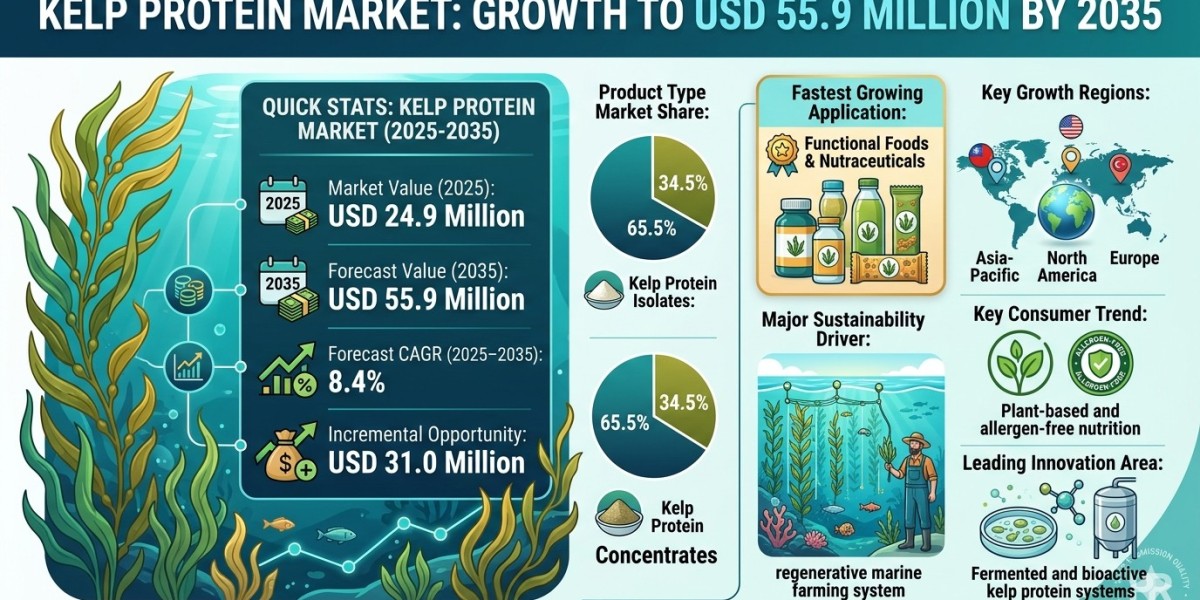
The global kelp protein market is projected to grow from USD 24.9 million in 2025 to USD 55.9 million by 2035, registering a compound annual growth rate (CAGR) of 8.4% during the forecast period. Market expansion is being fueled by rising consumer demand for sustainable plant-based proteins, increasing adoption of marine-derived functional ingredients, and growing utilization of kelp protein across dietary supplements, food & beverages, animal nutrition, and nutraceutical applications.
The kelp protein industry is transitioning from a niche marine nutrition segment into a commercially scalable alternative protein ecosystem supported by regenerative aquaculture, advanced seaweed processing technologies, and clean-label nutritional innovation.
Kelp protein is increasingly being positioned as a sustainable, nutrient-dense alternative to conventional animal and crop-based proteins due to its rich amino acid profile, low environmental footprint, and broad functionality across health-focused product formulations.
Quick Stats: Kelp Protein Market
- Market Value (2025): USD 24.9 Million
- Forecast Value (2035): USD 55.9 Million
- Forecast CAGR (2025–2035): 8.4%
- Incremental Opportunity: USD 31.0 Million
- Leading Product Type: Kelp Protein Isolates – 65.5% share
- Kelp Protein Concentrates Segment: 34.5% share
- Fastest Growing Application: Functional Foods & Nutraceuticals
- Key Growth Regions: Asia-Pacific, North America, and Europe
- Major Sustainability Driver: Regenerative marine farming systems
- Key Consumer Trend: Plant-based and allergen-free nutrition
- Leading Innovation Area: Fermented and bioactive kelp protein systems
The kelp protein market is evolving from an emerging marine ingredient category into a strategically important sustainable protein ecosystem supported by clean-label nutrition trends, functional wellness products, and environmentally responsible food production systems.
Manufacturers are increasingly focusing on advanced extraction technologies, protein bioavailability enhancement, fermentation-based processing, and regenerative aquaculture systems to improve scalability and strengthen market competitiveness.
Market Share Across Alternative Protein & Functional Nutrition Ecosystem
- Plant-Based Protein Industry: ~2–4% share
- Marine-Derived Functional Ingredients Market: ~8–10% share
- Nutraceutical Protein Supplements Segment: ~5–7% share
- Sustainable Alternative Proteins Industry: ~3–5% share
- Functional Food Ingredients Market: ~2–3% share
These figures highlight kelp protein’s growing strategic importance within sustainable nutrition, marine biotechnology, and functional wellness ecosystems.
Key Growth Drivers
- Rising Demand for Sustainable Protein Alternatives: Consumers are increasingly seeking environmentally responsible protein sources with lower land, water, and carbon footprints
- Expansion of Functional Foods & Nutraceuticals: Kelp protein is gaining traction in digestive wellness, immunity support, sports nutrition, and healthy aging products
- Growing Popularity of Plant-Based Diets: Vegan, flexitarian, and allergen-free dietary trends are accelerating kelp protein adoption globally
- Advancements in Seaweed Cultivation Technologies: Improved aquaculture systems and processing methods are enhancing scalability, consistency, and product quality
Technological Advancements & Production Innovation
The kelp protein market is witnessing rapid transformation through advanced marine biotechnology and precision extraction systems:
- Fermentation-based kelp protein enhancement technologies
- Enzyme-assisted seaweed protein extraction systems
- Bioactive peptide and isolate formulation innovations
- Sustainable regenerative kelp cultivation methods
Manufacturers are increasingly integrating marine biotechnology, precision nutrition science, and low-impact aquaculture systems to improve digestibility, amino acid concentration, taste optimization, and functional performance.
Product Innovation Trends
Manufacturers are expanding innovation pipelines with:
- Kelp protein-based sports nutrition powders
- Functional beverages with marine-derived proteins
- Fermented kelp protein digestive wellness systems
- Plant-based meat and dairy alternatives
- Kelp protein-enriched meal replacement products
These developments are supporting rising demand for clean-label, nutrient-rich, and sustainable alternative protein products globally.
Pricing and Market Stability
The market continues to maintain strong long-term growth potential despite evolving cultivation and processing cost dynamics:
- Kelp protein isolates: Premium pricing supported by purity and functionality advantages
- Nutraceutical-grade kelp proteins: Strong commercialization opportunities driven by wellness demand
- Functional food applications: Expanding retail penetration supported by clean-label positioning
- Sustainable marine farming systems: Long-term operational advantages through regenerative cultivation
Improved seaweed biotechnology, marine farming scalability, and functional ingredient innovation are supporting long-term market stability and supply chain resilience.
? Get Access to the Report Sample: https://www.futuremarketinsights.com/reports/sample/rep-gb-17743
Regional Outlook
The United States remains one of the largest kelp protein markets due to growing demand for plant-based nutrition, functional wellness products, and sustainable food innovation.
Germany continues to strengthen its market position through strong consumer demand for organic, traceable, and clean-label protein ingredients.
China remains a major growth hub supported by expanding functional food consumption, traditional wellness applications, and large-scale seaweed cultivation infrastructure.
Japan continues to witness stable growth driven by advanced marine biotechnology, healthy aging nutrition trends, and long-standing consumer familiarity with seaweed-based foods.
India is emerging as one of the fastest-growing markets due to rising plant-based nutrition awareness, expanding nutraceutical industries, and increasing demand for sustainable protein alternatives.
Asia-Pacific overall is expected to witness the strongest long-term expansion due to large-scale seaweed farming capacity, rising health consciousness, and growing functional food adoption.
Segmental Insights
Kelp Protein Isolates Segment
The kelp protein isolates segment is expected to account for 65.5% of total market revenue by 2025, making it the dominant product category.
Its leadership is supported by high bioavailability, superior amino acid profiles, and increasing use in dietary supplements, sports nutrition products, and plant-based food systems.
Manufacturers are increasingly investing in organic and minimally processed kelp protein isolates to meet rising clean-label consumer demand.
Kelp Protein Concentrates Segment
The kelp protein concentrates segment is projected to contribute 34.5% of total market revenue by 2025.
Growing utilization in fortified foods, dairy alternatives, high-protein snacks, and meal replacement systems continues to strengthen demand across mainstream food and beverage applications.
Industry Transformation Outlook
The kelp protein market is increasingly transitioning toward advanced marine nutrition ecosystems as consumers prioritize sustainability, wellness, and alternative protein diversity.
Growing integration of fermented seaweed proteins, bioactive marine peptides, and regenerative aquaculture systems is expected to redefine long-term market competitiveness.
Manufacturers are also increasing investments in low-carbon marine farming, sustainable packaging systems, and precision nutrition technologies to align with evolving global environmental and health priorities.
Future Outlook
The kelp protein market is expected to witness sustained long-term growth, supported by:
- Expansion of plant-based and sustainable protein ecosystems
- Rising demand for functional and clean-label nutrition
- Increasing use in sports nutrition and healthy aging products
- Growth of regenerative seaweed farming technologies
- Technological advancements in protein extraction and fermentation
- Expansion of marine-derived nutraceutical and wellness applications
As consumers increasingly prioritize environmental sustainability, nutritional density, and functional wellness, kelp protein is expected to strengthen its strategic role across global alternative protein, nutraceutical, and functional food ecosystems.
About the Market
The kelp protein market represents a rapidly expanding segment within the global alternative proteins, marine biotechnology, and functional nutrition industries. Its growing role in plant-based wellness, sustainable food systems, digestive health, and clean-label product innovation positions it as a strategically important category across food, nutraceutical, sports nutrition, and environmental sustainability sectors.
About Future Market Insights (FMI)
Future Market Insights (FMI) is a leading provider of market intelligence and consulting services, serving clients across more than 150 countries. Headquartered in Newark, FMI delivers actionable insights across industries including food ingredients, marine biotechnology, healthcare, advanced manufacturing, packaging, and sustainable technologies.
An ESOMAR-certified research organization, FMI provides syndicated market research reports and data-driven consulting services to Fortune 1000 companies, institutional investors, and emerging enterprises worldwide.
See Full Report View : https://www.futuremarketinsights.com/reports/kelp-protein-market