
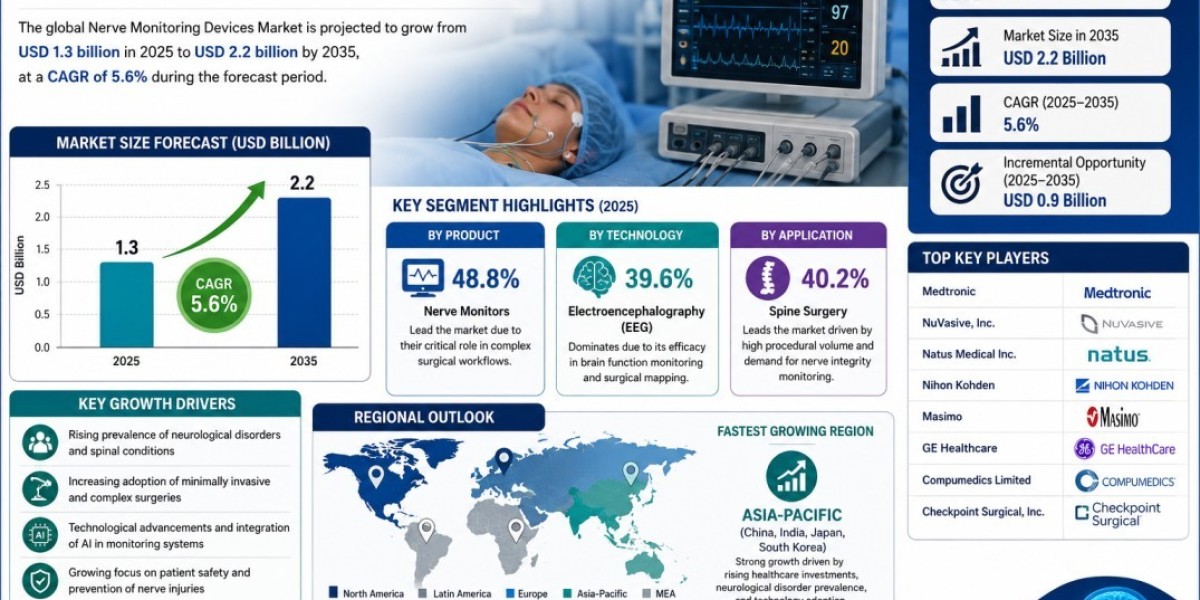
According to Future Market Insights (FMI), the global nerve monitoring devices market is expected to witness steady growth, driven by the increasing prevalence of neurological disorders, rising demand for minimally invasive surgeries, growing emphasis on patient safety, and continuous advancements in intraoperative neurophysiological monitoring technologies. Healthcare providers worldwide are increasingly adopting advanced nerve monitoring solutions to improve surgical precision, reduce postoperative complications, and enhance patient outcomes.
Quick Stats Snapshot – Nerve Monitoring Devices Market
- 2025 Market Size: USD 1.3 billion
- 2035 Forecast: USD 2.2 billion
- CAGR (2025–2035): 5.6%
- Leading Product Segment: Nerve Monitor Devices (48.8% share)
- Leading Technology Segment: Electroencephalography (EEG) (39.6% share)
- Leading Application Segment: Spine Surgery (40.2% share)
- Incremental Opportunity (2025–2035): USD 0.9 billion
- Key Growth Region: Asia-Pacific (China, India, Japan, South Korea)
- Key Players: Medtronic, NuVasive, Inc., Natus Medical Inc., Nihon Kohden, Masimo, GE Healthcare, Compumedics Limited, Checkpoint Surgical, Inc., Inomed Medizintechnik GmbH, Dr. Langer Medical GmbH, Neurovision Medical Products
Request For Sample: https://www.futuremarketinsights.com/reports/sample/rep-gb-958
Market Size and Outlook
The global nerve monitoring devices market is projected to grow from USD 1.3 billion in 2025 to USD 2.2 billion by 2035, registering a CAGR of 5.6% during the forecast period.
Market growth is being supported by the rising incidence of neurological disorders, increasing surgical volumes, and expanding adoption of intraoperative nerve monitoring systems across neurosurgery, spine surgery, ENT procedures, and cardiovascular interventions. Hospitals and specialty surgical centers are increasingly investing in advanced monitoring technologies to improve surgical safety and preserve nerve function during complex procedures.
The growing integration of nerve monitoring systems with robotic-assisted surgeries, AI-based signal interpretation platforms, and minimally invasive surgical techniques is further transforming the competitive landscape.
Growth Drivers: Rising Surgical Complexity and Demand for Patient Safety
The market is primarily supported by growing demand for accurate, real-time nerve function assessment during surgical procedures.
- Increasing Prevalence of Neurological Disorders: Growing incidence of epilepsy, Parkinson’s disease, spinal disorders, and neurodegenerative conditions driving demand for monitoring solutions
- Rising Number of Complex Surgical Procedures: Higher volumes of neurosurgical, spinal, thyroid, and ENT surgeries requiring nerve preservation
- Growing Adoption of Minimally Invasive Surgery: Advanced procedures increasing the need for real-time intraoperative monitoring
- Integration with Robotic-Assisted Surgical Systems: Improved surgical precision and reduced risk of nerve injury supporting device adoption
- Technological Advancements in Neurophysiology: AI-enhanced signal processing and multimodal monitoring improving diagnostic accuracy
- Emphasis on Value-Based Healthcare: Hospitals focusing on reducing complications and improving patient outcomes
These factors continue to strengthen long-term growth prospects for the nerve monitoring devices market globally.
Key Challenges: Reimbursement Limitations and Operational Complexity
Despite favorable market conditions, several challenges continue to affect industry growth:
- High Equipment Costs: Advanced nerve monitoring systems requiring significant capital investments
- Limited Reimbursement Coverage: Inadequate reimbursement frameworks restricting adoption in certain regions
- Training and Expertise Requirements: Need for specialized technicians and neurophysiology professionals
- Signal Accuracy and Workflow Challenges: Real-time monitoring requiring precise electrode placement and interpretation
Organizations investing in automation, clinician training programs, and AI-assisted monitoring platforms are expected to strengthen their market position.
Access Full Report: https://www.futuremarketinsights.com/reports/nerve-monitoring-devices-market
Opportunities: AI Integration and Advanced Surgical Navigation
Several emerging opportunities are reshaping the nerve monitoring devices landscape:
- AI-Powered Monitoring Platforms: Advanced algorithms reducing false alarms and improving signal interpretation
- Integration with Robotic Surgery Systems: Enhanced surgical precision and improved nerve preservation capabilities
- Expansion of Multimodal Monitoring Technologies: Combining EEG, EMG, EP, and ECOG systems for comprehensive assessment
- Cloud-Based Data Management Solutions: Automated reporting, data archiving, and outcome tracking capabilities
- Growth in Minimally Invasive and Outpatient Procedures: Increasing need for compact, portable, and user-friendly monitoring systems
These developments are expected to improve surgical efficiency, enhance patient safety, and create new growth opportunities for market participants.
Segmentation Insights: Nerve Monitors and EEG Technology Lead Market Demand
- Product Segment: Nerve Monitor Devices dominate with a 48.8% share due to growing use in high-risk surgeries requiring continuous nerve assessment
- Technology Segment: Electroencephalography (EEG) accounts for 39.6% share owing to its critical role in brain activity monitoring, cortical mapping, and anesthesia assessment
- Application Segment: Spine Surgery leads with 40.2% share due to increasing procedural volumes and heightened focus on nerve preservation
- Technology Trend: AI-enhanced signal processing and multimodal neuro-monitoring systems gaining significant adoption
- Surgical Trend: Growing integration with robotic-assisted and image-guided surgical platforms supporting market expansion
Regional Analysis: Asia-Pacific Emerges as a Key Growth Hub
Asia-Pacific is expected to witness significant growth due to expanding healthcare infrastructure, increasing neurological disease burden, and rising surgical volumes.
- United States: Strong market demand supported by advanced healthcare infrastructure, high surgical volumes, and widespread adoption of intraoperative neurophysiological monitoring
- United Kingdom: Growing investments in neurodiagnostics and increasing prevalence of spinal disorders supporting market growth
- European Union: Rising focus on patient safety, technological innovation, and treatment of neurodegenerative diseases driving adoption
- Japan: Growth supported by advanced neurosurgical capabilities, aging demographics, and increasing demand for minimally invasive procedures
- South Korea: Expanding use of nerve monitoring technologies in ENT, orthopedic, and neurosurgical procedures boosting market expansion
- Asia-Pacific: Increasing healthcare investments and broader access to advanced surgical technologies creating substantial opportunities
Competitive Landscape: Innovation and Clinical Integration Drive Competition
The nerve monitoring devices market remains highly competitive, with companies focusing on innovation, product enhancement, and strategic collaborations.
Leading organizations focus on:
- Developing AI-enabled nerve monitoring systems
- Enhancing real-time signal processing and visualization capabilities
- Expanding robotic surgery integration platforms
- Improving portability and workflow efficiency
- Strengthening partnerships with hospitals and surgical centers
Recent industry developments include next-generation intraoperative monitoring platforms, cloud-based reporting solutions, advanced EEG technologies, and integration with surgical navigation systems.
Strategic Implications for Decision-Makers
The nerve monitoring devices market presents significant opportunities driven by increasing demand for safer surgical procedures and advanced neuro-monitoring technologies.
- Healthcare providers should prioritize advanced nerve monitoring systems to improve surgical outcomes and reduce postoperative complications
- Hospitals and specialty clinics can benefit from investments in AI-powered monitoring platforms and integrated surgical technologies
- Investors may capitalize on growing adoption of robotic-assisted surgery and neuro-monitoring solutions
- Manufacturers focusing on automation, interoperability, and real-time analytics are expected to strengthen long-term market positioning
As healthcare systems continue to prioritize surgical precision, patient safety, and technology-enabled care delivery, nerve monitoring devices are expected to play an increasingly critical role in supporting complex surgical procedures and improving neurological outcomes worldwide.
About Future Market Insights (FMI)
Future Market Insights (FMI) is a leading provider of market intelligence and consulting services, serving clients across more than 150 countries. Headquartered in Delaware, USA, with a global delivery center in India and offices in the UK and UAE, FMI delivers actionable market insights across healthcare, technology, manufacturing, energy, chemicals, and consumer industries.
For Press & Corporate Inquiries:
Rahul Singh
AVP – Marketing and Growth Strategy
Future Market Insights, Inc.
+91 8600020075
For Sales – sales@futuremarketinsights.com
For Media – Rahul.singh@futuremarketinsights.com
For Web – www.futuremarketinsights.com