
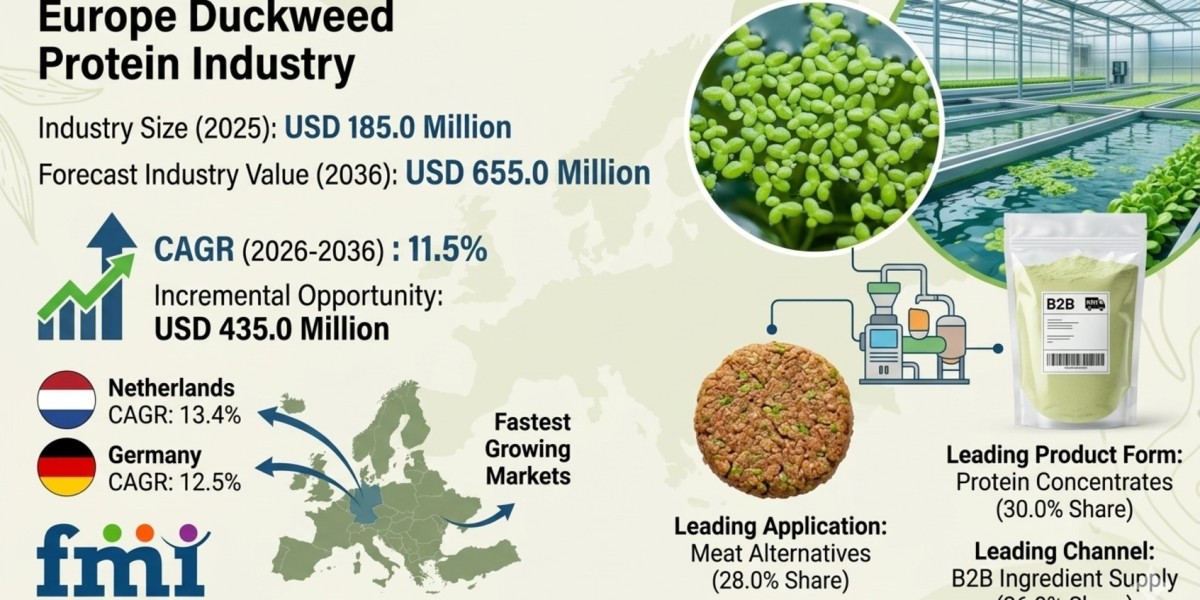
The Europe Duckweed Protein Industry is poised for rapid expansion, according to latest insights by future market insights. The industry was valued at USD 185.0 million in 2025 and is estimated to reach USD 220.0 million in 2026. Over the forecast period from 2026 to 2036, the market is projected to expand at a CAGR of 11.5%, reaching approximately USD 655.0 million by 2036. Growth is being fueled by increasing demand for sustainable plant-based proteins, expanding applications in meat alternatives and functional foods, rising investments in novel protein commercialization, and growing consumer preference for clean-label nutrition products.
Key Europe Duckweed Protein Industry Projections
- Industry Size (2025): USD 185.0 Million
- Industry Size (2026): USD 220.0 Million
- Forecast Industry Value (2036): USD 655.0 Million
- CAGR (2026-2036): 11.5%
- Incremental Opportunity: USD 435.0 Million
- Leading Product Form: Protein Concentrates (30.0% Share)
- Leading Application: Meat Alternatives (28.0% Share)
- Leading Channel: B2B Ingredient Supply (26.0% Share)
- Fastest Growing Markets: Netherlands (13.4% CAGR) and Germany (12.5% CAGR)
- Key Growth Driver: Rising Adoption of Sustainable and Functional Alternative Proteins
Request a Sample Report: https://www.futuremarketinsights.com/reports/sample/rep-gb-14254
Strategic Market Insights
Duckweed protein is emerging as one of the most promising next-generation protein ingredients within Europe’s rapidly expanding alternative protein ecosystem. Food manufacturers are increasingly exploring duckweed-derived proteins as a solution for improving sustainability credentials, reducing reliance on conventional protein sources, and supporting clean-label product development.
The industry is transitioning from research-focused projects to commercial-scale ingredient adoption. Product developers are evaluating duckweed proteins for their nutritional profile, functionality, water-binding properties, and compatibility across multiple food applications. As regulatory frameworks evolve and ingredient qualification processes mature, commercial demand is expected to strengthen significantly.
Growing consumer awareness of environmental sustainability, protein diversification, and plant-based nutrition continues to support industry expansion. Manufacturers are increasingly seeking protein ingredients capable of delivering both nutritional value and formulation performance while aligning with evolving consumer expectations.
Analyst Perspective
“The Europe duckweed protein market is entering a critical commercialization phase. Companies that can consistently deliver food-grade quality, application support, and scalable production capabilities will be best positioned to convert pilot projects into long-term commercial relationships,” said Nandini Roy Choudhury, Principal Analyst at FMI.
Competitive Landscape and Market Share Analysis
The Europe duckweed protein industry remains fragmented and highly specialized, with competition centered on cultivation technology, ingredient functionality, regulatory compliance, processing capabilities, and formulation expertise.
Unlike traditional protein markets where brand recognition plays a dominant role, competitive success within duckweed protein depends heavily on technical readiness and commercial reliability. Buyers prioritize ingredient consistency, cultivation control, food safety documentation, and formulation support when selecting suppliers.
As commercialization accelerates, suppliers are investing in advanced cultivation systems, protein extraction technologies, ingredient optimization programs, and customer-specific application development services.
Leading Market Participants Include
- Plantible Foods
- Rubisco Foods
- Hinoman
- Parabel
- GreenOnyx
- LemnaPro
- DryGro
Competition increasingly focuses on ingredient functionality, cultivation efficiency, supply consistency, regulatory readiness, and commercial-scale production capabilities.
Production vs. Consumption Economy Analysis
The production side of the duckweed protein industry remains dependent on controlled cultivation systems, efficient harvesting methods, and advanced extraction technologies. Maintaining compositional consistency and food-grade quality standards remains essential for securing regulatory approvals and commercial adoption.
On the consumption side, demand is primarily concentrated among food manufacturers developing plant-based foods, meat alternatives, functional nutrition products, sports nutrition formulations, and premium wellness offerings. As ingredient familiarity increases, demand is expected to expand beyond early adopters into mainstream food applications.
Countries such as the Netherlands, Germany, Belgium, and France continue to drive innovation and commercialization efforts, creating a strong foundation for future industry growth.
Supply Chain and Value Chain Insights
The duckweed protein value chain begins with controlled cultivation, harvesting, protein extraction, ingredient processing, quality validation, formulation testing, distribution, and final incorporation into food and nutrition products.
Ingredient qualification remains a critical stage within the value chain because manufacturers require extensive validation regarding safety, nutritional composition, functionality, and processing performance before large-scale adoption.
Companies continue investing in traceability systems, cultivation optimization, extraction efficiency improvements, and quality assurance protocols to strengthen supply chain reliability and support industry growth.
Strategic Procurement Analysis
Procurement teams evaluating duckweed protein suppliers increasingly prioritize consistency, scalability, regulatory compliance, application support, and food safety documentation.
Food manufacturers seek suppliers capable of delivering reliable ingredient performance across multiple product categories while maintaining compositional stability and quality consistency. Technical support during formulation and commercialization phases has become a key supplier selection criterion.
As demand grows, procurement strategies are expected to place greater emphasis on long-term supply agreements, cultivation capacity, and production scalability.
Custom Research Available: https://www.futuremarketinsights.com/customization-available/rep-gb-14254
Country Opportunity Assessment
Netherlands
The Netherlands is expected to remain the fastest-growing market through 2036, registering a CAGR of 13.4%. Strong alignment between research institutions, commercial developers, and alternative protein innovators continues to support rapid industry growth.
Germany
Germany is projected to expand at a CAGR of 12.5% through 2036. The country's advanced food manufacturing sector and growing commitment to protein diversification create favorable conditions for duckweed protein adoption.
Belgium
Belgium is anticipated to register a CAGR of 12.2%, supported by active pilot programs, commercialization initiatives, and increasing collaboration between agricultural and food innovation stakeholders.
France
France is forecast to grow at a CAGR of 12.0% through 2036. Expanding demand for premium nutrition, functional foods, and sustainable ingredients continues to create new growth opportunities.
Denmark
Denmark is expected to expand at a CAGR of 11.8%, supported by strong sustainability initiatives, plant-based food innovation, and growing premium nutrition demand.
United Kingdom
The United Kingdom is projected to grow at a CAGR of 11.6% during the forecast period, driven by demand for differentiated protein ingredients across retail and nutrition product categories.
Spain
Spain is expected to register a CAGR of 10.9% through 2036 as plant-based food adoption increases and ingredient suppliers continue demonstrating practical commercial applications.
Technology and Innovation Outlook
Key innovations influencing the Europe duckweed protein industry include:
- Controlled aquatic cultivation systems
- Advanced protein extraction technologies
- Novel protein purification techniques
- Functional ingredient optimization
- Food-grade quality validation systems
- Digital traceability platforms
- Sustainable production technologies
- Customized protein formulation solutions
Manufacturers continue investing in technologies that improve protein yield, ingredient consistency, scalability, and application performance.
Segment Analysis
By Product Form
Protein Concentrates are expected to dominate the industry with a 30.0% share in 2026. These products offer an effective balance between protein content, functionality, processing efficiency, and cost-effectiveness, making them attractive for early-stage commercialization.
Protein isolates, fresh duckweed biomass, powdered duckweed, organic protein products, and customized nutrition inputs are also expected to gain market traction as application development expands.
By Application
Meat Alternatives are projected to account for 28.0% of industry demand in 2026. Manufacturers increasingly seek protein ingredients capable of supporting texture, nutritional value, and clean-label positioning within a single formulation.
Functional foods, sports nutrition, premium nutrition, bakery products, snacks, and clinical nutrition applications are also expected to contribute significantly to market growth.
By Channel
B2B Ingredient Supply is expected to account for 26.0% of market demand in 2026. Since duckweed protein remains primarily an ingredient-focused category, technical partnerships and formulation support continue to drive commercial adoption.
Direct sales, specialty channels, distributors, online channels, retail, and modern trade are expected to expand as market awareness increases.
Future Industry Outlook
The Europe Duckweed Protein Industry is expected to benefit from rising demand for sustainable protein ingredients, increasing plant-based food innovation, expanding commercialization of novel proteins, and growing interest in clean-label nutrition solutions.
Although regulatory approvals, cultivation scalability, and ingredient qualification remain important challenges, continued investments in cultivation technologies, extraction systems, and formulation support are expected to accelerate adoption across Europe.
Companies capable of delivering consistent quality, scalable production, technical expertise, and strong customer support will be best positioned to capitalize on growth opportunities through 2036.