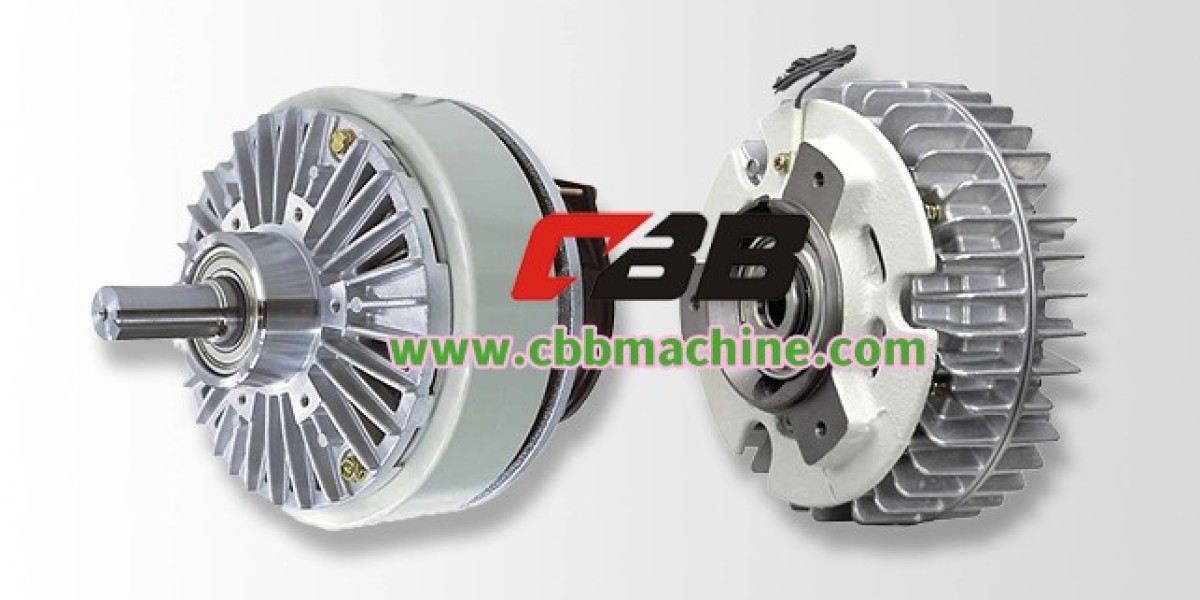
In many industrial converting environments, the Magnetic Powder Clutch designed by Cbbmachine provides a practical approach to managing torque transmission between rotating components. Within machines that process continuous materials, stable power transfer is essential for maintaining balanced movement, especially when materials must accelerate, slow down, or maintain steady motion during complex operations.
Production lines that handle films, paper, laminates, and flexible materials rely on coordinated movement across several mechanical sections. Each section contributes to guiding, stretching, printing, coating, or winding the substrate. When the transfer of rotational force becomes uneven, tension may shift and material alignment can become unstable. Because of this, equipment designed to regulate torque plays a key role in maintaining order within the system.
A powder based clutch mechanism introduces a unique solution to this challenge. Inside the device, fine magnetic particles respond to an electromagnetic field generated during operation. As the field changes, the particles connect the driving and driven components through a controllable friction layer. This interaction allows torque to pass between rotating elements with gradual engagement rather than abrupt mechanical contact.
Such behavior is particularly valuable in machines that require precise adjustment of tension during continuous production. When material movement changes from slow feeding to steady processing, the clutch responds by adjusting the connection between rotating shafts. This response helps maintain stable motion without sudden force changes that could disturb the material path.
The ability to modulate torque smoothly supports a wide range of industrial activities. Converting lines use controlled torque to regulate unwinding of raw material rolls. Printing equipment benefits from stable motion as substrates move through printing stations. Laminating processes require balanced movement so multiple material layers can align properly. In each of these cases, controlled torque transmission contributes to consistent operation.
Design considerations extend beyond function alone. Engineers often seek components that integrate comfortably with existing mechanical systems. Equipment that adapts to various machine layouts allows manufacturers to incorporate improved torque control without redesigning entire production lines. Compact structures and practical installation options help simplify integration within diverse industrial environments.
Maintenance and long term usability also influence equipment selection. Production facilities operate continuously, and components must remain dependable under frequent use. When mechanical structures are designed with accessible internal elements and balanced construction, routine inspection and servicing become easier for maintenance teams. This practicality helps support uninterrupted manufacturing schedules.
From the perspective of machine operators, consistent torque behavior improves the overall production experience. Equipment that reacts smoothly to adjustments allows operators to focus on material quality and workflow efficiency. Instead of compensating for sudden mechanical changes, they can monitor production conditions with greater confidence.
The evolution of manufacturing technology continues to highlight the importance of precise mechanical control. Systems capable of regulating torque, tension, and motion contribute to smoother operation across increasingly complex production environments. Quiet components inside these machines often determine how effectively materials move from one stage of processing to the next.
Curiosity about the mechanisms behind modern converting equipment often begins with a single question. For those interested in seeing how thoughtful mechanical design shapes industrial motion, the next step is simple. Visit https://www.cbbmachine.com/news/industry-news/can-magnetic-powder-clutches-improve-torque-control-in-manufacturing.html and step into a deeper view of the technology working behind today's production lines.