
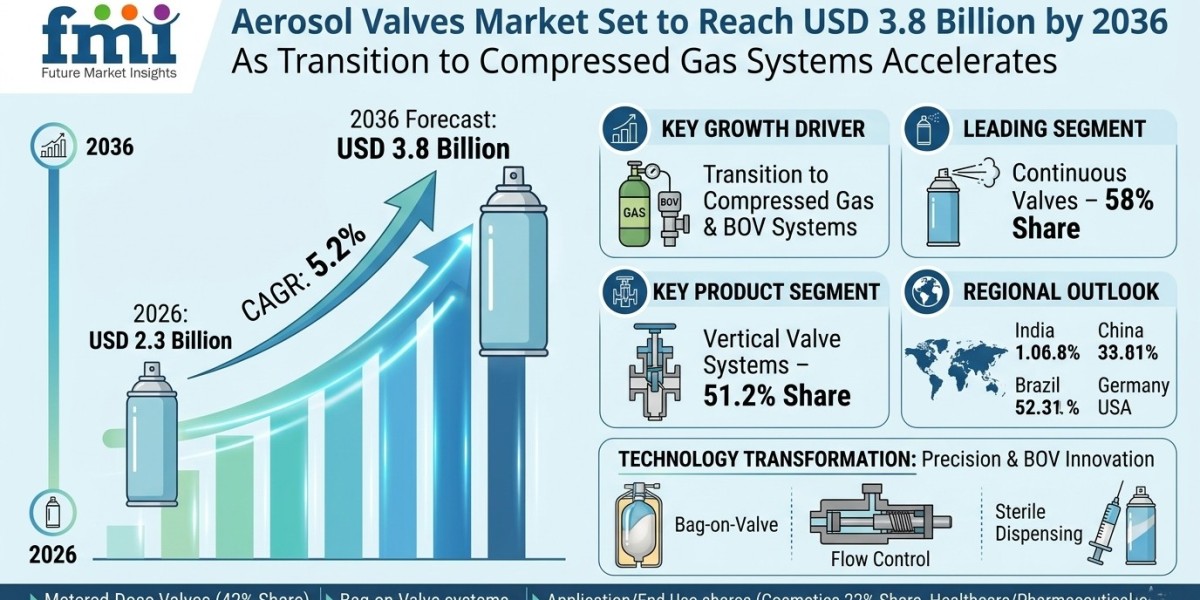
The global aerosol valves market is projected to expand steadily as industries adopt advanced dispensing technologies and environmentally compliant aerosol systems. The market is estimated to reach USD 2.3 Billion in 2026 and is expected to grow to USD 3.8 Billion by 2036, registering a CAGR of 5.2% during the forecast period.
Quick Stats: Aerosol Valves Market (2026–2036)
- Market Value (2026): USD 2.3 Billion
• Forecast Value (2036): USD 3.8 Billion
• CAGR: 5.2%
• Leading Segment: Continuous Valves – 58% market share
• Key Product Segment: Vertical Valve Systems – 51.2% share
• Fastest-Growing Countries: India, China, Brazil, Germany, United States
• Key Growth Driver: Transition from hydrocarbon propellants to compressed gas and BOV dispensing technologies
Structural Growth Driver: Transition Toward Sustainable Propellant Systems
A major structural driver shaping the aerosol valves market is the industry-wide transition toward environmentally sustainable propellant systems. Governments across North America and Europe are strengthening regulations related to volatile organic compounds (VOCs) and per- and polyfluoroalkyl substances (PFAS), which historically have been used in valve sealing materials and aerosol formulations.
These regulatory pressures are accelerating the development of compressed gas propellant systems and Bag-on-Valve technologies, which enable manufacturers to reduce emissions while maintaining spray precision and product stability. As a result, valve manufacturers are redesigning components, including elastomer seals, mounting cups, and actuators, to ensure compatibility with these alternative dispensing systems.
At the same time, multinational consumer goods companies are demanding aerosol components that support sustainability targets, recyclability standards, and regulatory compliance across multiple markets.
Key regulatory and industry frameworks include:
- VOC emission reduction regulations
• PFAS chemical restrictions in packaging materials
• Aerosol packaging recyclability standards
• Sustainable material certification requirements
• Environmental manufacturing compliance frameworks
From Compliance to Industry Transformation
The aerosol valves market is moving beyond regulatory compliance and entering a broader phase of industry transformation centered on precision dispensing technologies. Companies are increasingly positioning themselves as providers of integrated dispensing solutions rather than commodity valve suppliers.
Large manufacturers are expanding their production networks to ensure regional supply chain proximity to aerosol filling operations. Recent investments in Germany, Brazil, and Mexico demonstrate the growing importance of regional manufacturing capacity in maintaining cost efficiency and delivery reliability.
At the same time, the aerosol packaging ecosystem is shifting toward more specialized segments such as pharmaceutical dispensing, nasal drug delivery systems, and premium personal care packaging, which offer significantly higher margins compared to traditional consumer product valves.
Key priorities for manufacturers now include:
- Sustainability performance improvements
• Cost efficiency and material optimization
• High recyclability and eco-compatible components
• Compatibility with compressed gas systems
• Supply chain localization and resilience
Technology Transformation: Precision Dispensing and BOV Innovation
Technological innovation is playing a critical role in reshaping the aerosol valves market. Manufacturers are focusing on improving spray precision, flow control, and product dispersion efficiency, which enhances the performance of aerosol packaging across pharmaceutical, personal care, and industrial applications.
Bag-on-Valve systems are gaining significant traction due to their ability to isolate the product from propellants, enabling sterile delivery, reduced contamination risk, and extended shelf life. These systems are particularly important in pharmaceutical aerosols, where dosage accuracy and hygiene standards are essential.
At the same time, automation and advanced tooling technologies are improving manufacturing precision and reducing production defects in valve components.
Key innovation areas include:
- Advanced material development
• Automation integration in valve manufacturing
• Lightweight valve component design
• Sustainable material engineering
• Manufacturing efficiency improvements
Segment Highlights
By Product Type
- Continuous Valves (58% share): Widely used in air fresheners, cleaning sprays, and personal care products due to consistent and uninterrupted product dispensing.
- Metered-Dose Valves (42% share): Essential in pharmaceutical applications where precise dosage control is required, particularly for inhalers and nasal spray systems.
- Bag-on-Valve Systems: Growing adoption in pharmaceutical and premium cosmetic packaging due to improved product protection and reduced contamination risk.
- Eco-Compatible Valves: Emerging segment designed for compressed gas propellant compatibility.
- High-Precision Actuator Systems: Increasing demand in specialty aerosol applications.
By Application / End Use
- Cosmetics & Personal Care (22% share): Leading segment driven by deodorants, hair sprays, and body care products.
- Healthcare & Pharmaceuticals: High-margin segment supported by inhalers, nasal drug delivery, and medical aerosol formulations.
- Homecare Products: Cleaning sprays, disinfectants, and air fresheners driving large-volume demand.
- Automotive Applications: Used in lubricants, tire inflators, and maintenance sprays.
- Food & Beverage Applications: Specialty aerosol dispensing for whipped cream and cooking sprays.
Regional Outlook: Emerging Economies Drive Adoption
Global growth in the aerosol valves market is shaped by regional specialization. Europe leads in precision valve engineering, North America drives pharmaceutical aerosol demand, while Latin America is emerging as a cost-efficient manufacturing hub with new production facilities supporting global supply chains. Meanwhile, Asia Pacific is witnessing strong growth in personal care and household aerosol products due to rising urbanization and consumer spending.
Country growth outlook includes:
- India (6.3% CAGR): Rapid urbanization and growing demand for personal care aerosols are boosting market expansion.
- China (5.9% CAGR): Government sustainability policies are encouraging the adoption of eco-friendly aerosol packaging technologies.
- Brazil (5.7% CAGR): New manufacturing investments are strengthening regional supply chains for aerosol valve production.
- Germany (4.8% CAGR): Advanced engineering capabilities and strict environmental regulations support innovation in precision valves.
- United States (5.1% CAGR): Strong demand from pharmaceutical aerosol and consumer goods industries.
Risk Landscape: Market Constraints and Challenges
Despite strong growth prospects, the aerosol valves industry faces several structural challenges related to manufacturing complexity, regulatory compliance, and supply chain dependencies.
Key challenges include:
- Raw material price volatility
• Supply chain disruptions in precision tooling
• Infrastructure gaps in emerging markets
• Regulatory complexity across regions
• High manufacturing and material costs
Competitive Landscape: Key Market Players
The aerosol valves market is highly consolidated, with a small number of specialized manufacturers controlling a significant portion of the global supply chain. These companies maintain strong competitive positions through proprietary valve technologies, extensive production capabilities, and long-term partnerships with multinational aerosol product manufacturers.
Top companies include:
- AptarGroup, Inc.
• LINDAL Group
• Coster Group
• Summit Packaging Systems
• Precision Valve Corporation
Other notable companies include Mitani Valve Co., Ltd., Clayton Corporation, Newman Green Inc., The Salford Valve Company Ltd., and Weener Plastics.
Outlook: Future of the Aerosol Valves Market
The future of the aerosol valves market will be defined by innovation in dispensing technology, sustainability initiatives, and regional manufacturing expansion. As aerosol packaging continues to evolve across personal care, healthcare, and industrial sectors, manufacturers will increasingly focus on precision engineering and environmentally compliant designs.
Future growth drivers include:
- Technology advancement in dispensing systems
• Sustainability initiatives in packaging design
• Manufacturing expansion in emerging markets
• Supply chain innovation and localization
For an in-depth analysis of evolving industry trends and to access the complete strategic outlook for the market through 2036, visit the official report page at: https://www.futuremarketinsights.com/reports/aerosol-valves-market