
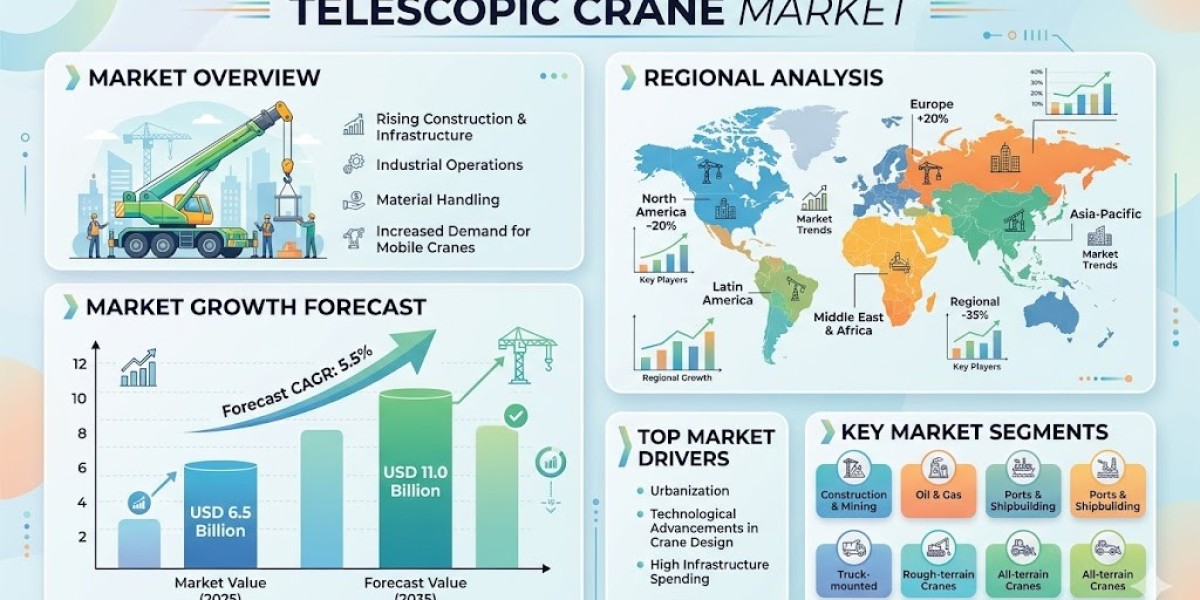
The global Telescopic Crane Market is witnessing steady growth as construction activity, infrastructure modernization, and industrial expansion drive demand for versatile lifting equipment worldwide. The market is projected to grow from USD 6.5 billion in 2025 to USD 11.0 billion by 2035, registering a CAGR of 5.5% over the forecast period.
Telescopic cranes are widely valued for their extendable boom design, enabling efficient lifting operations across varying heights and distances. Their ability to operate in confined job sites while maintaining strong lifting capacity makes them a preferred choice for construction, logistics, mining, and industrial maintenance projects.
Request For Sample Report | Customize Report | Purchase Full Report –
https://www.futuremarketinsights.com/reports/sample/rep-gb-24132
Key Market Statistics Highlight Long-Term Industry Momentum
Market analysis indicates a steady growth trajectory supported by infrastructure investments and increasing adoption of flexible lifting equipment across industries.
Key Market Data
- Market Size (2025): USD 6.5 billion
- Market Forecast (2035): USD 11.0 billion
- Projected CAGR (2025–2035): 5.5%
- Incremental Market Opportunity: USD 4.5 billion
- Leading Product Segment: Truck-mounted telescopic cranes (39.6% share)
The rising need for mobile cranes that deliver high lifting performance while maintaining operational efficiency is strengthening long-term market prospects.
Infrastructure and Urbanization Fuel Market Expansion
Infrastructure development remains the primary driver of telescopic crane demand globally. Rapid urbanization and the construction of large-scale infrastructure projects require versatile equipment capable of lifting heavy components in complex environments.
Major sectors contributing to market growth include:
- Transportation infrastructure such as highways, rail networks, and bridges
- High-rise residential and commercial construction
- Renewable energy installations including wind turbines
- Industrial facility construction and modernization
Between 2025 and 2030, rising project activity is expected to push market revenues beyond USD 8.5 billion, with continued expansion through 2035.
Truck-Mounted Telescopic Cranes Dominate Product Landscape
Among product types, truck-mounted telescopic cranes remain the most widely used lifting equipment due to their mobility and quick deployment capabilities.
Reasons for Segment Leadership
- Fast setup and operational flexibility
- Ability to move easily between job sites
- Reduced requirement for additional transport equipment
- High suitability for urban construction and maintenance work
The segment is expected to account for 39.6% of total market revenue in 2025, reinforcing its leading position in the industry.
Strong Demand for Cranes with Up to 20 Tons Lifting Capacity
Light-to-medium lifting applications continue to dominate construction and maintenance operations, driving strong adoption of cranes with lower lifting capacities.
Key Advantages of the Up to 20 Tons Segment
- Lower equipment acquisition and operating costs
- Compact design suitable for restricted job sites
- Reduced fuel consumption and easier transport
- Ideal for commercial construction and maintenance projects
This segment is projected to hold 26.3% of market share by 2025, supported by growing construction activity in developing economies.
Hydraulic Telescopic Cranes Maintain Operational Leadership
Hydraulic operation modes remain the most widely adopted system in the telescopic crane market due to superior performance and control capabilities.
Benefits of Hydraulic Telescopic Cranes
- Smooth and controlled boom extension
- High lifting precision and operational safety
- Lower maintenance requirements compared to alternative systems
- Improved efficiency in harsh working environments
Hydraulic cranes are expected to represent 64.8% of total market revenue in 2025, reflecting their dominance in heavy lifting applications.
Equipment Rental Market Expands Access to Advanced Cranes
The equipment rental sector has become a major contributor to market growth. Many construction companies prefer renting telescopic cranes rather than investing in capital-intensive equipment purchases.
Drivers Behind Rental Market Expansion
- Short-term project requirements
- Reduced upfront investment for contractors
- Access to modern and technologically advanced equipment
- Flexible fleet availability across multiple job sites
Fleet operators are also investing in digital monitoring technologies that improve maintenance scheduling, operator safety, and equipment utilization.
Asia-Pacific Leads Global Market Growth
Regional demand patterns indicate strong growth across developing economies, particularly in Asia-Pacific where infrastructure investments remain significant.
Fastest Growing Markets
- China: 7.4% CAGR driven by large-scale construction projects
- India: 6.9% CAGR supported by urban development and industrial expansion
- Germany: 6.3% CAGR tied to infrastructure modernization
- United Kingdom: 5.2% CAGR due to growing urban construction activity
- United States: 4.7% CAGR driven by logistics and renewable energy projects
Asia-Pacific will remain the largest demand hub for telescopic cranes, supported by ongoing investments in transportation, energy infrastructure, and urban housing developments.
Competitive Landscape Focused on Technology and Efficiency
The global telescopic crane industry is highly competitive, with manufacturers investing heavily in innovation, automation, and safety technologies.
Leading companies are focusing on:
- Advanced load monitoring systems
- IoT-based crane performance analytics
- AI-assisted safety and stability systems
- Lightweight high-strength structural materials
- Electrified and hybrid crane powertrains
Key Market Players
- Liebherr-International AG
- Tadano Ltd.
- The Manitowoc Company, Inc.
- SANY Group Co., Ltd.
- XCMG Group
- Zoomlion Heavy Industry Science & Technology Co., Ltd.
- Terex Corporation
- Kobelco Construction Machinery Co., Ltd.
- Furukawa UNIC Corporation
- Manitex International, Inc.
- Hitachi Sumitomo Heavy Industries Construction Crane Co., Ltd.
As construction technology evolves and sustainability becomes a key industry priority, equipment manufacturers are expected to accelerate innovation in smart crane systems and low-emission lifting equipment.