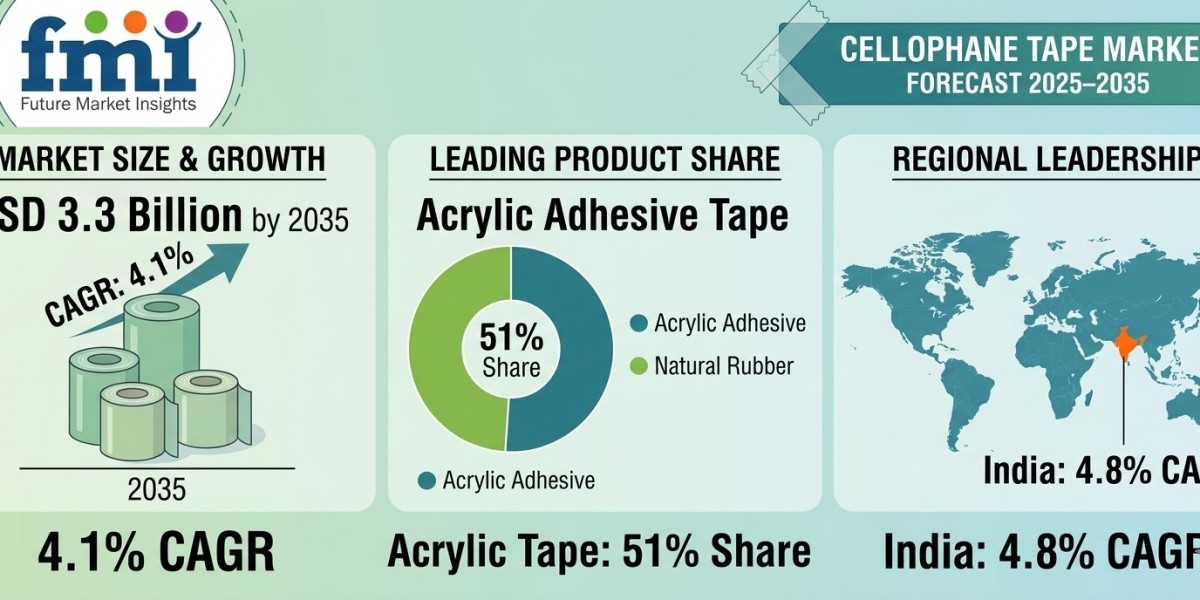
The global cellophane tape market is projected to expand steadily over the next decade, growing from an estimated USD 2.2 billion in 2025 to USD 3.3 billion by 2035, reflecting a CAGR of 4.1%. Growth is primarily fueled by the rising packaging demands of the e-commerce sector, coupled with increasing adoption in retail, education, and office supply chains. Additionally, innovations in specialty tapes with tamper-evident, weather-resistant, and eco-friendly properties are contributing to sustained market momentum.
Market transformation is being driven by an industry-wide shift toward sustainable and biodegradable alternatives, such as regenerated cellulose-based tapes. Companies are integrating advanced adhesive formulations, automation in manufacturing, and versatile product designs to meet evolving regulatory and consumer expectations. The stationery, office supplies, and packaging segments remain key revenue contributors, while logistics and e-commerce operations continue to stimulate high-volume consumption globally.
Quick Stats: Cellophane Tape Market (2025–2035)
- Market Value (2025): USD 2.2 Billion
• Forecast Value (2035): USD 3.3 Billion
• CAGR: 4.1%
• Leading Segment: Transparent Tape – 46% share
• Key Product Segment: Acrylic Adhesive Tape – 51% share
• Fastest-Growing Countries: India, China, USA, Canada, Germany
• Key Growth Driver: Expansion of e-commerce and sustainable tape adoption
Structural Growth Driver: E-Commerce and Retail Packaging Demand
The growing e-commerce ecosystem is creating strong demand for cellophane tapes with superior adhesion and tamper-evident properties. Online retailers require packaging solutions that are efficient, durable, and compatible with automated dispensers. Regulatory pressures in regions like Europe and North America are encouraging adoption of eco-friendly adhesives, driving the development of biodegradable cellulose-based tapes.
Companies are responding by enhancing production capabilities, incorporating environmentally sustainable processes, and ensuring compliance with global quality standards. Consumer preference for visually clear and recyclable tapes also accelerates uptake in stationery and packaging segments.
Key regulatory and industry frameworks include:
• Recycling regulations
• Certification requirements for adhesive products
• Material sustainability guidelines
• Manufacturing quality standards
From Compliance to Industry Transformation
Manufacturers are moving beyond mere compliance toward strategic adoption of sustainability and operational efficiency. The integration of automated dispensers and high-precision coating systems has transformed manufacturing workflows, while the supply chain has adapted to support higher volumes of roll-format and eco-grade tapes. Businesses are prioritizing solutions that minimize environmental impact without compromising on performance.
End-users and companies now focus on combining functionality with regulatory compliance, particularly in regions enforcing plastic reduction and green procurement policies. Strategic investments in R&D for advanced adhesive formulations and specialty tapes are fostering industry-wide transformation.
Key company priorities include:
• Sustainability performance
• Cost efficiency
• Recyclability
• Operational compatibility
Technology Transformation: Innovation in Adhesive Formulation
Technological advancements in material science and automation are reshaping the cellophane tape market. Development of long-lasting acrylic adhesives, UV-stable transparent films, and temperature-resistant tapes ensures reliability across e-commerce logistics, office supply, and industrial applications. Automation in coating, slitting, and dispensing processes is improving efficiency and reducing labor dependency.
Innovation areas include:
• Advanced material development
• Automation integration
• Lightweight tape designs
• Sustainable material engineering
• Manufacturing efficiency improvements
Segment Highlights
By Type
- Transparent Tape (46% share): Dominates due to clarity and versatility in packaging, office, and retail applications.
• Colored Tape (18% share): Used in labeling, decoration, and color-coding processes.
• Decorative Tape (12% share): Applied in arts, crafts, and promotional activities.
• Printed Tape (10% share): Supports branding, tamper-evidence, and product identification.
By Application
- Stationery (22% share): Schools, offices, and households use tapes for document sealing and repairs.
• Packaging (40% share): High-volume consumption in e-commerce and logistics.
• Label Protection (20% share): Shields barcodes and printed materials from damage.
• Arts & Crafts (10% share): Growing segment in educational and hobbyist markets.
Regional Outlook: Emerging Economies Drive Adoption
The cellophane tape market is experiencing strong growth in Asia-Pacific and other emerging economies due to expanding e-commerce and retail sectors. North America and Europe demonstrate steady adoption, driven by regulatory mandates and office supply demand.
- India (4.8% CAGR): Rising demand in organized retail, education, and FMCG packaging.
• China (4.5% CAGR): Growth supported by logistics expansion and export-focused tape manufacturing.
• Brazil (3.9% CAGR): Steady consumption in retail and commercial sectors.
• Germany (3.7% CAGR): Adoption of eco-friendly tapes in compliance with EU Green Deal guidelines.
• United States (4.0% CAGR): Consistent demand in packaging, office, and niche industrial applications.
Risk Landscape: Market Constraints and Challenges
The market faces constraints including raw material price fluctuations, regulatory complexity, and competitive pressures. Adoption of sustainable alternatives may also require higher capital investment in technology and production processes.
Key challenges include:
• Raw material price volatility
• Supply chain disruptions
• Infrastructure gaps
• Regulatory complexity
• High manufacturing costs
Competitive Landscape: Key Market Players
Competition remains concentrated among leading global and regional manufacturers, with players focusing on technological innovation, brand strength, and distribution networks. Strategic partnerships, mergers, and product diversification are shaping the competitive landscape.
Top 5 Key Companies:
• Henkel (Sellotape)
• Panfix
• Bagla Group
• Twin Tech India
• Shree Shubh Industries
Other notable companies include Louis Tape, Globe Industries Corporation, Packaging Peddler, Ajilo International, and Intertape Polymer Group.
Outlook: Future of the Cellophane Tape Market
The cellophane tape market is poised for sustained growth driven by e-commerce expansion, technological advancements, and regulatory emphasis on sustainable materials. Companies are expected to invest in R&D, automation, and eco-friendly adhesive formulations to meet evolving consumer and industrial demands.
Future growth drivers:
• Technology advancement
• Sustainability initiatives
• Manufacturing expansion
• Supply chain innovation
visit the official report page at: https://www.futuremarketinsights.com/reports/cellophane-tape-market