
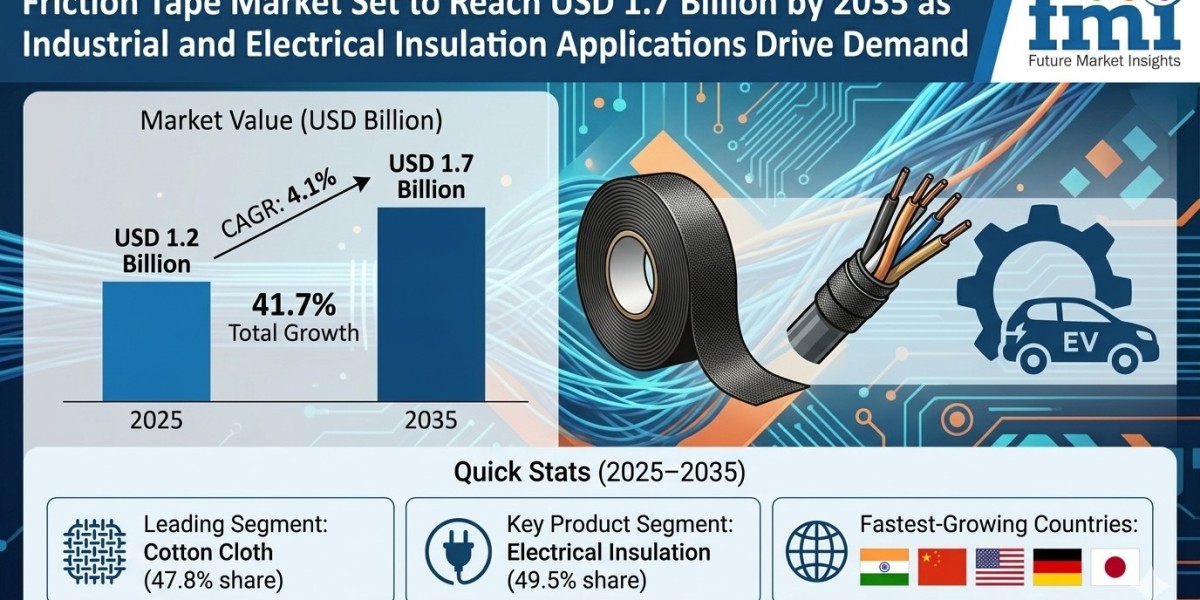
The global friction tape market is entering a steady growth phase, driven by rising demand for durable, high-performance insulation and protective wrapping solutions across industrial, electrical, and automotive sectors. Valued at USD 1.2 billion in 2025, the market is projected to reach USD 1.7 billion by 2035, reflecting a compound annual growth rate (CAGR) of 4.1% over the forecast period. This growth represents a 41.7% total increase in market size, reflecting sustained adoption in both repair and original equipment manufacturing applications.
The market is witnessing a notable industry transformation, driven by increased emphasis on safety-critical applications, renewable energy installations, electric vehicle (EV) production, and specialized industrial equipment maintenance. Cloth-backed tapes with high friction coefficients continue to dominate due to their durability, tensile strength, and abrasion resistance, while solvent-free and eco-friendly adhesive formulations are gaining traction in response to regulatory and sustainability pressures.
Quick Stats: Friction Tape Market (2025–2035)
- Market Value (2025): USD 1.2 Billion
• Forecast Value (2035): USD 1.7 Billion
• CAGR: 4.1%
• Leading Segment: Cotton Cloth (47.8% share)
• Key Product Segment: Electrical Insulation (49.5% share)
• Fastest-Growing Countries: India, China, USA, Germany, Japan
• Key Growth Driver: Rising demand in electrical, industrial, and automotive applications
Structural Growth Driver: Industrial and Electrical Application Expansion
The friction tape market is primarily propelled by the increasing demand for reliable mechanical protection and electrical insulation. Electrical contractors, industrial maintenance service providers, and automotive OEMs are prioritizing high-tensile, abrasion-resistant tapes to ensure operational reliability in high-friction environments.
Regulatory frameworks and safety standards across electrical and industrial sectors are reinforcing market adoption. Compliance with international standards such as ASTM, IEC, and ISO ensures that friction tapes meet performance requirements for insulation, tensile strength, and heat resistance. Environmental and sustainability mandates are also accelerating adoption of solvent-free adhesives and recyclable backings.
Key Regulatory and Industry Standards:
• Recycling regulations
• Certification requirements (ASTM, IEC)
• Material sustainability guidelines
• Manufacturing standards for adhesive and backing quality
From Compliance to Industry Transformation
Friction tape manufacturers are adapting by integrating advanced material science and process innovations into their product lines. Companies are increasingly focusing on durability, heat and abrasion resistance, and adhesion on irregular surfaces. This trend is reflected in both traditional cotton cloth tapes and specialized rubber-resin blends.
Industry adoption is also influenced by broader supply chain transformation. Manufacturers are aligning production with sustainability and ESG requirements, while distributors optimize inventory tracking and supply logistics to ensure availability in emerging markets.
Companies prioritize:
• Sustainability performance
• Cost efficiency
• Recyclability
• Operational compatibility
Technology Transformation: Adhesive and Material Innovation
Technological innovation in the friction tape market is focused on enhancing mechanical performance, adhesive reliability, and eco-friendly formulations. Automation in manufacturing, advanced calendaring techniques, and solvent-free adhesive development are central to improving production efficiency and product consistency. Material science advancements are driving lightweight yet durable tape options suitable for high-stress environments.
Innovation Areas:
• Advanced material development
• Automation integration
• Lightweight design
• Sustainable material engineering
• Manufacturing efficiency improvements
Segment Highlights
By Material Type:
• Cotton Cloth (47.8% share): Durable and flexible, ideal for electrical and industrial wrapping
• Rubber-Resin Blend (32.4% share): High adhesion and moisture resistance for harsh environments
• Non-woven Fabric (19.8% share): Lightweight, flexible, suitable for specialized applications
By Application:
• Electrical Insulation (49.5% share): Critical for wiring systems and high-voltage equipment
• Grip Enhancement (21.3% share): Used in sports equipment and hand tools
• Tool Wrapping (15.2% share): Enhances safety and ergonomics
• Sports Equipment (14.0% share): Provides traction and durability under high-friction conditions
Regional Outlook: Emerging Economies Drive Adoption
The friction tape market is witnessing significant growth in Asia-Pacific and North America, driven by industrialization, power distribution expansion, and automotive manufacturing. Developed regions focus on performance upgrades and sustainability compliance, while emerging economies benefit from infrastructure expansion.
- India (5.4% CAGR): Driven by electrification projects, power grid modernization, and automotive harness production
• China (5.1% CAGR): Rapid industrialization and EV adoption fuel high-voltage insulation tape demand
• Brazil (4.3% CAGR): Infrastructure growth and renewable energy initiatives increase tape adoption
• Germany (4.1% CAGR): Automotive and renewable energy sectors drive demand for premium-grade tapes
• United States (4.5% CAGR): Industrial maintenance and electrical safety compliance support steady growth
Risk Landscape: Market Constraints and Challenges
While demand for friction tape continues to rise, certain challenges may restrain market growth. Limited weather resistance of traditional rubber adhesives, competition from alternative insulation materials, and price volatility are critical factors.
Key Challenges:
• Raw material price volatility
• Supply chain disruptions
• Infrastructure gaps
• Regulatory complexity
• High manufacturing costs
Competitive Landscape: Key Market Players
The friction tape market is moderately fragmented, featuring global adhesive leaders, regional manufacturers, and niche specialty tape suppliers. Companies compete based on tensile strength, adhesion, environmental compliance, and customization capabilities.
Top 5 Key Companies:
• Euro Tapes Pvt. Ltd.
• Medi Spare
• AVR Industries Private Limited
• Champion Tape
• Goyal Electric Works
Other notable companies include 3M Company, Tesa SE, Scapa Group, Shurtape Technologies, and Intertape Polymer Group.
Outlook: Future of the Friction Tape Market
The friction tape market is expected to expand steadily, driven by continued electrification, industrial automation, and adoption of sustainable materials. Manufacturers will increasingly leverage smart adhesives, high-performance backings, and eco-friendly formulations to address evolving market needs.
Future Growth Drivers:
• Technology advancement
• Sustainability initiatives
• Manufacturing expansion
• Supply chain innovation
visit the official report page at: https://www.futuremarketinsights.com/reports/friction-tape-market